3,974 Covid-19 cases reported in a single day in Pakistan


ISLAMABAD: The National Command and Operation Centre (NCOC) data, released on Wednesday, showed that 3,974 new cases of Covid-19 and 66 deaths caused by the disease were reported in a single day and the national positivity rate remained at 6.91 per cent.
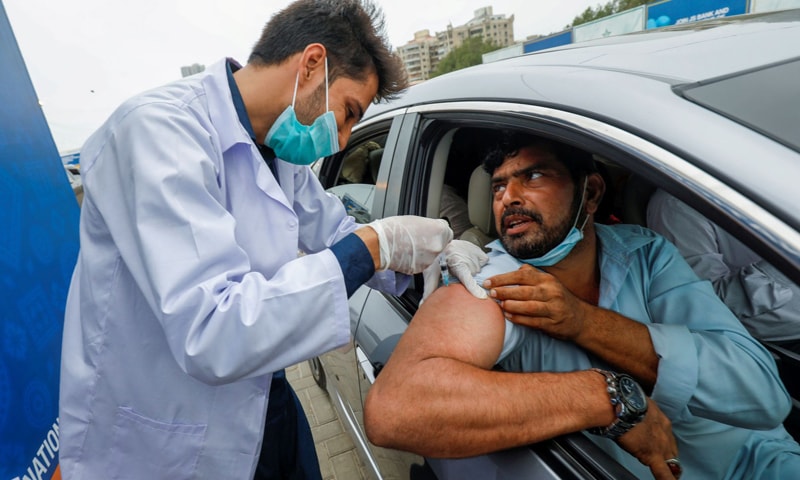
While 44.32 million doses of vaccine have been administered, vaccination centres will remain closed on 10th of Muharram (today) across the country.
Meanwhile, the World Health Organisation (WHO) has announced that it will stay in Afghanistan to respond to Covid-19.
The NCOC data showed that the number of active cases was 88,209 as of August 18. As many as 73pc oxygen beds allocated for Covid-19 patients were occupied in Abbottabad, 60pc in Swat, 56pc in Gujranwala and 55pc in Karachi. Overall 491 ventilators were in use by Covid-19 patients across the country.
So far 1,109,274 cases have been detected and 996,426 patients have recovered in the country. As many as 24,639 deaths have been reported and 5,364 patients admitted to hospitals.
While foreigners have been trying to leave Afghanistan, the WHO has announced that it will stay in the country and continue to work with partners to combat Covid-19.
Positivity ratio stands at 6.9pc
WHO Regional Director for the Eastern Mediterranean Dr Ahmed Al-Mandhari, in a statement, said that the organisation was committed to staying in Afghanistan and deliver critical health services. He called on all parties to respect and protect civilians, health workers, patients and health facilities.
“During this difficult time, the well-being of all civilians — as well as the safety and security of our staff — in Afghanistan is paramount. Sustained access to humanitarian assistance, including essential health services and medical supplies, is a critical lifeline for millions of Afghans, and must not be interrupted. Months of violence have taken a heavy toll on Afghanistan’s fragile health system, which had already been facing shortages in essential supplies amid the Covid-19 pandemic,” he said.
“As a result of the recent conflict, trauma injuries have increased, requiring scaled up emergency medical and surgical services. In July 2021, some 13,897 conflict-related trauma cases were received at 70 WHO-supported health facilities, compared to 4,057 cases in July 2020. Despite the insecurity, on 17 August WHO dispatched to Wazir Akbar Khan Hospital in Kabul 33 units of different modules of trauma kits, enough to cover 500 surgical procedures for 500 trauma patients and 750 burn victims, and 10 basic medical kits enough to provide essential medicines for 10,000 people for 3 months,” he said.
Dr Al-Mandhari said this week the WHO also provided a hospital in Helmand with six basic medical supply kits and one cholera kit to support the provision of basic medicines for 6,000 people for three months and the management of 100 cases of diarrhoea.
“Over the past 3 months, health staff in 10 referral hospitals have been provided with training in mass casualty management. Since January, WHO has provided trauma care support to 134 health facilities in 34 provinces. These hospitals have reported 20,988 trauma cases in the past 2 months. Since June, WHO provided 500 health facilities with emergency kits and medical supplies. WHO is also training health workers in mental health support. WHO and partners have conducted an initial assessment of the health needs of displaced populations and have deployed 2 mobile health teams to provide medical services. However, interventions have been on hold for the past 36 hours due to insecurity,” he said.
“In areas where people have fled to seek safety and shelter, including Kabul and other large cities, field reports indicate that there are increasing cases of diarrhoea, malnutrition, high blood pressure, Covid-19-like symptoms and reproductive health complications. Delays and disruptions to health care will increase the risk of disease outbreaks and prevent some of the most vulnerable groups from seeking life-saving health care. There is an immediate need to ensure continuity of health services across the country, with a focus on ensuring women have access to female health workers. Furthermore, attacks on health care remain a major challenge,” he said.
Published in Dawn, August 19th, 2021