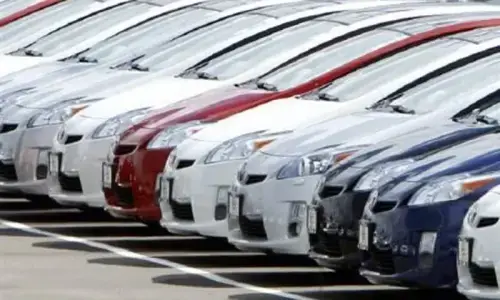
As wars are being fought in the Middle East, auto assemblers are seeing varied responses from consumers in Pakistan. Some assemblers and their dealers appear a bit cautious about the intensity of the ongoing US-Iran-Israel war, as they have been witnessing a slowdown in showroom footfall.
An assembler of Korean automobiles said buyers’ order intake has reduced, but it cannot be said this is purely because of the war, since car purchasing usually remains thin in the early days of Ramazan and then picks up in the second half of the holy month, targeting pre-Eid buying.
He said he cannot give the exact drop in showroom buyers, but “I can say that this war has definitely shattered buying sentiments.” Some dealers also say that consumers have adopted a wait-and-see attitude amid the Middle East conflict, as uncertainty has gripped the market.
However, a Punjab-based assembler of Japanese cars, while responding to the sales outlook under the current uncertain business environment, said, “No big impact, things are normal.” Similarly, a banker in auto financing simply said, “Everything is ok,” citing no impact from the ongoing war on the auto market.
Demand for small, petrol-driven cars and their financing may rise further owing to fuel price hikes amid forecasts of further increases
Another assembler said that demand for small, petrol-driven cars and their financing may further rise owing to a massive Rs55-per-litre increase in petrol prices and amid forecasts of further price increases. The locally assembled Suzuki Alto 660cc, which is already in high demand, may turn out to be a main beneficiary, along with some 1,000cc cars, in the future.
On May 10, 2025, Pakistan and India agreed to a ceasefire after four days of intense fighting. This brief war with the neighbour also did not pose any serious threat to the auto sector as sales during May 2025 stood at 14,762 units, reflecting a 35 per cent year-on-year (YoY) and 39pc month-on-month (MoM) rise.
The 12-day June 2025 Iran-Israel war also did not have much consequence on sales of cars, sports utility vehicles (SUVs), pickups and vans, which remained brisk. Auto sales in June 2025 clocked in at 21,773 units, posting a 64pc YoY and 47pc MoM jump.
The Pakistan-Afghanistan war, which started ahead of Ramazan and is still ongoing, has remained a non-issue for new vehicle buyers, as February 2026 sales stood at 17,121 units, up by 42pc YoY but down 26pc MoM.
Analysts did not link the sharp MoM decline in February 2026 to the Afghan-Pakistan war, but rather to a high base effect as January sales typically surge due to new-year vehicle registrations, coupled with fewer working days in February. The YoY growth was supported by new market entrants, lower interest rates of 10.5pc from 22pc in June 2024, easing inflation, and improving macroeconomic sentiments.
Furthermore, the growing craze among the elites for electric vehicles (EVs) and newer petrol-driven models has boosted car, SUV, pickup, and van sales to 128,498 units during 8MFY26, up 43pc YoY from 89,770 units in 8MFY25.
As the Iran-US-Israel war enters the second week, its repercussions are now visible in the form of a Rs55 per litre increase in petrol and diesel prices, driven by a massive rise in crude oil prices, with looming uncertainty over future petrol and diesel prices and fears of a fuel shortage.
As nobody is clear about the war scenario in the coming days, a Top Line Security analyst still expects positive momentum in auto sales to continue in 2026, supported by lower interest rates and new hybrid and plug-in hybrid models. Additionally, the easing inflation and improved economic activity should further strengthen demand in the coming months.
However, the real picture of production and sales for March 2026 will emerge next month, when the Pakistan Automotive Manufacturers Association releases the auto data in the second week of April.
CEO Indus Motor Company (IMC), Ali Asghar Jamali, said, “All issues will start coming in the future. The supply chain will be disrupted massively. Freight costs will become high. Inflation pressures will also come. Things are looking serious. We need to keep evaluating it.”
A Karachi-based assembler said the ongoing conflict in the region has introduced uncertainty and is likely to impact the automotive industry. Rising oil prices are expected to increase costs across the supply chain — from raw material procurement to vehicle distribution — affecting inputs such as plastic resins, paint coatings, logistics, freight, and tyre production. The situation remains fluid, with early signs already visible as local fuel prices have increased by nearly 20pc.
Sales momentum could continue into 2026, provided two key conditions are maintained: macroeconomic stability and a consistent, growth-oriented auto policy for the next five to 10 years, he said.
On EV prospects, he said growth in hybrids, plug-in hybrids (PHEVs), and electric vehicles (EVs) will depend largely on the direction and continuity of the Auto Policy 2026–2031. The industry has recommended extending the tax incentives currently available for environment-friendly technologies — including hybrids, PHEVs, and battery-electric vehicles — to support broader adoption going forward.
Despite the visible transition toward electrified options, internal combustion engine (ICE) vehicles are expected to retain a significant share in Pakistan’s market due to affordability considerations for mass-market consumers, he said.
Among electrified options, hybrids currently represent the most practical and affordable option toward gradual electrification in Pakistan. Consumer adoption also reflects this reality, with hybrid sales significantly outpacing those of other electrified technologies.
Recognising this trend, assemblers including Japanese, Korean, and Chinese manufacturers have collectively introduced over 10 locally assembled hybrid models, along with five PHEV and one range extended electric vehicle (REEV) models, reflecting substantial investment in local hybrid production.
Wider adoption of battery electric vehicles (BEVs) is likely to take longer due to structural challenges such as limited charging infrastructure, affordability constraints, and concerns around resale value, which remain important considerations for local consumers.
Given that nearly 55pc of four-wheeler demand in Pakistan is for small cars under 1,000cc, where viable hybrid or PHEV options are still limited, fossil fuel-driven vehicles will continue to play an important role. In this context, hybrids remain the preferred transition technology, offering a balance between affordability, fuel efficiency, and lower emissions.
He said EV adoption in Pakistan is also influenced by structural factors such as charging infrastructure availability, affordability, resale considerations, and policy clarity, which affect all market players. Currently, producing locally made EVs with batteries above 50 kWh remains commercially challenging due to the prevailing tax structure, which treats such vehicles to 25pc general sales tax (GST), compared to 18pc GST on completely built units (CBU) EV imports — an issue the industry has raised with the government on multiple occasions.
At the provincial level, Punjab is leading EV adoption through initiatives such as EV taxi schemes, government procurement programs, charging infrastructure development, and active engagement with industry stakeholders. Similar initiatives by other provinces could help accelerate Pakistan’s transition toward cleaner mobility, particularly as the country faces increasing climate risks, the assembler said.
Published in Dawn, The Business and Finance Weekly, March 16th, 2026