THE exit of American and Nato troops from Afghanistan’s Bagram airbase which was completed on Friday, signals the end of an era, one that saw another failed attempt by Western states at nation-building and the ‘airlifting’ of democracy.
Bagram served as a grim example of how the West, particularly the US, set up notorious ‘black sites’ — under the garb of the ‘war on terror’ — that were practically gulags where the fundamental rights of prisoners were trampled on freely. Abu Ghraib in Iraq and Guantanamo Bay in Cuba are other members of this unenviable list.
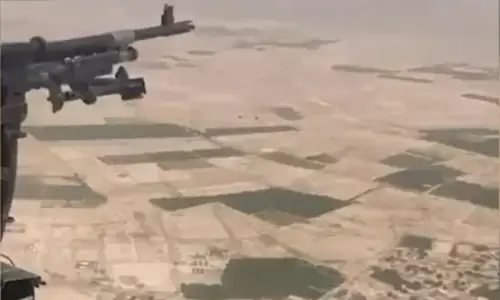
Once a modest Cold War airfield, Bagram was transformed into a sprawling fortress that projected American military power in the aftermath of 9/11 many thousands of miles from the US homeland. But today, now that the Americans and their allies have quit Bagram, it is fair to ask: has their ‘mission’ been accomplished? With the clouds of uncertainty swirling around Afghanistan’s future following the exit of foreign forces, the answer is clearly in the negative.
The fact is that the involvement of foreign forces in Afghanistan — first the Soviets in 1979 and later the Americans and their Nato cohorts — has only prolonged the Afghan nightmare. While Afghan political forces and warlords are no doubt also to blame for the dysfunction that haunts their land, the interference of foreign powers and the playing of geopolitical games on Afghan soil have had a major part in destabilising the country, and preventing an organic evolution and political process from taking root. Though it can be argued that Afghanistan has rarely seen stability, perhaps the script would have been written differently if the USSR and later the US had not meddled in the country over the last four decades and counting.
Explainer: When is the US war in Afghanistan really over?
Looking ahead, there are far too many unknowns where Afghanistan is concerned. As a Western diplomat based in Kabul told Reuters news agency recently, the US and Nato have “won many battles, but have lost the Afghan war”. This is quite clear, as the Afghan Taliban, emboldened by a series of victories, have their eyes set on Kabul. The Western-supported Afghan government seems unable to defend the country, particularly without the military muscle of its foreign protectors.
While Joe Biden has talked of “over the horizon capacity” to defend the Afghan government, he has also said in the same breath that the “Afghans are going to have to ... do it themselves”. The message seems clear: Kabul is on its own.
Of course, an ‘Islamic emirate of Afghanistan’ is not a palatable option, not for the world, and not for Pakistan, as this country’s senior civil and military leaders have indicated. If Afghanistan implodes again, very real concerns of terrorism and refugees will confront the world community, particularly its neighbours. For now, there are too many unanswered questions about Afghanistan, and no convincing answers.
Published in Dawn, July 4th, 2021