‘When we sing, we get something to eat’


ISLAMABAD: The difficulties facing folk artists and musicians came to the fore on Sunday at the inauguration of the 10-day Lok Mela.
The festival is held every year to showcase the cultural heritage of Pakistan.
The objective of this year’s folk festival is to reinforce and strengthen national integration by promoting the cultural heritage of the country, through the active participation of all the provinces, Gilgit-Baltistan and Azad Kashmir.
As per the tradition of the last several years, the inauguration ceremony began with the Dastarbandi, or Chaddar Poshi, of an established master craftswoman or craftsman. According to Lok Virsa, this is a symbol of its campaign to keep Pakistan’s heritage alive.
Folk artists’ difficulties come to the fore at opening of annual Lok Mela
This year the chaddar was presented to 64-year-old Saran Bibi, a thread-weaver from Tharparkar, who has been doing this work for 50 years.
Folk singer, 69-year-old Akhter Chanal Zehri from Qalat, Balochistan, was also presented a turban.
While addressing the ceremony, Inter-Provincial Coordination Minister Dr Fehmida Mirza emphasised the challenges facing folk artists, and called on the prime minister and Pakistani embassies to support them at home and abroad.
She quoted an artist who told her at the mela, “when we sing, we get something to eat”, which she said described the entire saga of misery.
She added that Saran Bibi had also told her about the problems she faces during the short time that she was receiving her chaddar during the ceremony.
Later, Saran Bibi told Dawn she told the minister that their crop yield had been low because of the lack of rain, which was adding to her difficulties.
“I am very weak now, and cannot work for longer periods. We don’t have crops this season, so we don’t get enough food to eat.
Her son Ravi, who was translating for his mother, said the only food they could get was roti, and they hadn’t eaten meat or fruit for months.
But, he said, they were happy that they would receive Rs10,000 from Lok Virsa for participating in the mela, which he said was millions to them.
When asked what she hopes to do with the money, Saran Bibi said they would buy enough groceries and eat their fill.
The musical performances in the second part of the ceremony began with a performance by Bano Rehmat from Kashmir.
Outfitted in traditional Kashmiri dress and jewellery, Ms Rehmat performed the folk song Nikki Nikki Loi.
She was followed by folk singer Shaukat Ali from Tharparkar, who also performed on the Khartal, an ancient instrument used mainly in devotional and folk music.
Mr Ali said he is the only musician left who plays this instrument, which consists of a pair of thin, hard wood pieces that are clapped together to make fast, complex beats.
His performance on the Khartal, along with his vocals and Sindhi dance created a beautiful atmosphere in the hall and invited audience members to join in.
Other performers included Jhangi Khan from Balochistan, Zamin Hussain from Khyber Pakhtunkhwa, Manzoor Baltistani from Baltistan and Fazal Ashiq Jutt from Punjab, who performed Apna Punjab Yaro to the loud beat of the dhol.
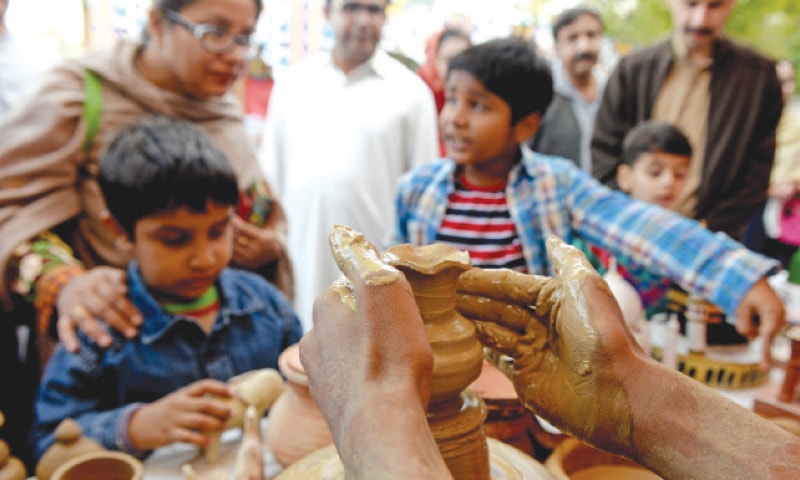
Hundreds of artisans, folk artists, performers and dancers from all over the country are participating in the festival.
Separate pavilions have been set up for each province to represent the traditional crafts, cuisine and music from each region.
Published in Dawn, November 5th, 2018