• Laments Pakistan has failed Balochistan
• Describes CPEC as complete development platform
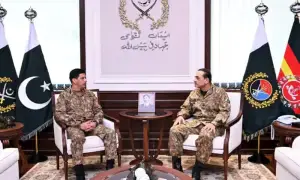
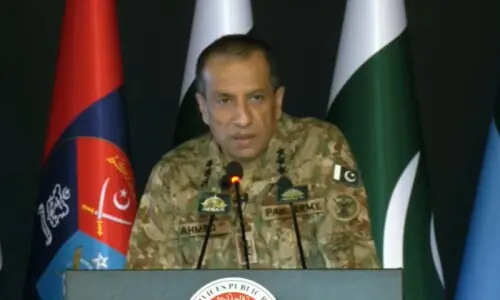
KARACHI: Chief of the Army Staff Gen Qamar Javed Bajwa has said that the army is keenly watching developments in the country’s economy and shares some of the apprehensions being voiced about it.
“The economy is showing mixed indicators,” he said before an audience of businessmen and the military leadership of Karachi at a daylong event organised by the Federation of Pakistan Chambers of Commerce and Industry (FPCCI) and Inter-Services Public Relations at the DHA Golf Club on Wednesday.
“Growth has picked up but the debts are sky high. [The situation regarding] infrastructure and energy have improved considerably but the current account balance is not in our favour.”
The closest Gen Bajwa came to identifying economic priorities was when he stressed the need for widening the tax base, bringing in fiscal discipline and ensuring continuity of economic policies.
The event was held to discuss the intermingling of economy and security in today’s Pakistan and the keynote address by the chief of the army staff was preceded by a rather wild and roving discussion among various panellists about where the economy stands today. Almost all the speakers spoke at length about the China-Pakistan Economic Corridor (CPEC) as the cornerstone of Pakistan’s economic future.
Speakers included Ishrat Husain, a former State Bank governor; Salman Shah, the financial adviser during the regime of Pervez Musharraf; Ashfaque Hasan Khan, former director general of the Debt Management Office, also under Musharraf; Zubair Tufail, Lt Gen Muhammad Afzal; DG of the Frontier Works Organisation; and the FPCCI president.
The army chief told the audience that in the past it was “fashionable” to say that economics had subsumed security, but with the reemergence of “parochial passions” today “security has once again become the foremost business and task of the state”.
A little later he underlined the importance of the economy for sustaining the security gains of the past few years, adding it “is high time for us to [give] economic growth and sustainability the highest priority. Let me share with you that during the National Security Council meetings, economy remains one of our highest concerns”.
He described Pakistan as “a strategically challenged state” where “external actors are attempting to assert control and dictate our security priorities that have strong linkages with our economic future. The centrepiece of this effort is the CPEC”.
The allusion appears to point towards the growing closeness between China and Pakistan, which is shaping up to be a security as well as an economic relationship. Most recently, US Secretary of Defence General James Mattis told Congress that the United States opposed CPEC because “it goes through disputed territory”.
The army chief himself described CPEC in grand terms. “This corridor is not just a collection of infrastructure and power projects — it is in fact a complete development platform that has the potential to act as a powerful springboard for shared development in the entire CASA (Central Asia-South Asia) region,” he said during his prepared remarks.
“However, the completion of the project and, more importantly, optimisation of its socio-economic dividend for Pakistan and the region hinges on one word: ‘security’,” he added.
When talking of the effort to establish security, he said “we need a comprehensive effort to pursue [the] National Action Plan”, and pointed towards police and judicial reforms as obvious examples of the sort of measures that must be implemented under it. Then he added madressah reforms to the list. “Madressah reforms are also vital — we cannot afford to leave a large segment of our youth with limited options. Madressahs must enable their students to become useful members of society who are not left behind in any field of life.”
Gen Bajwa described Pakistan’s external situation as “a belligerent India on our east and an unstable Afghanistan on our west”, and twice called for peace with neighbouring countries and his “genuine desire to have normal and peaceful relations with India; however it takes two to tango”.
Through most of his speech, the COAS read from a prepared text, departing from it on occasion. In one instance, he addressed a question raised by Marium Saba Chaudhry of the FPCCI, in which she had criticised some of the speakers on the panel discussion that preceded his keynote address, for referring to residential areas in Gwadar as “slums”.
“These are not slums” she objected. “The inhabitants are not occupying this land illegally. These people live in these areas of Gwadar from where they fear they are going to be evicted to make room for the CPEC-related projects,” she told the panel, adding that when you refer to their neighbourhoods as ‘slums’ it heightens their fears that their claim to their homes is being weakened in the run-up to a mass eviction.
The army chief began his remarks by acknowledging the point, telling Ms Chaudhry: “I will address your question after my remarks.” At the conclusion, he addressed Ms Chaudhry by name and told her that Balochistan was close to his heart. “We have failed Balochistan. Pakistan has failed Balochistan and we will not let it happen again.”
He ended his speech by reminding the assembled businessmen of their duty as he saw it, which included paying their taxes, since the contribution of direct taxes to Pakistan’s treasury was abysmally low. “We have done our part on the security front, now it’s up to you to take initiative and turn the economy around.”
Published in Dawn, October 12th, 2017