1
1
KARACHI: The increasing air and noise pollution is negatively affecting various busy thoroughfares and streets of the city, especially those running along some large hospitals and the pollution is taking its toll on the patients, it emerged on Thursday.
The M. A. Jinnah Road hosts many hospitals along its fringes and corners where the situation is getting graver for patients who otherwise needed extreme care and attention. Similar is the condition of Rafiqui Shaheed Road where apart from increasing pollution, the rusted sewerage system brings diseases instead of cure to patients of three major hospitals of the province located on it.
Experts said major hospitals like the Civil Hospital Karachi, the Services Hospital and several private hospitals along the M. A. Jinnah Road suffered because of growing pollution.
Similar situation could be witnessed on various busy streets in the city where the number of private hospitals is continuously on the rise as the managements are generally least concerned to take seriously the hazards of pollution.
Pollution levels in almost all of Pakistan’s major cities are nearly 10 times higher than maximum level recommended by the World Health Organisation.
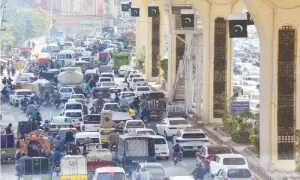
A free hand apparently given by the traffic police to rickshaws, taxis, minibuses, coaches and old buses and trucks to emit hazardous smoke — not to mention the noise — is the main reason behind the problems, the experts said.
Officials admitted that despite the provincial government’s decision to ban all public transport vehicles made before 1976, they were still running on the roads.
They said that according to estimates, over 2.5 million vehicles were on the city roads and the number was growing constantly as hundreds of vehicles are registered in Karachi daily.
A visit to some of those hospitals showed that due to blaring vehicle horns, the patients are unable to get a sound sleep and thus unable to get speedy recovery. “Patients must sleep to recover. It’s the significant factor,” said a doctor.
A patient at a private hospital near Sharea Faisal who underwent an operation recently said he had been unable to sleep at night, while the hospital was filled with smoke emitted by vehicles, particularly during the rush hour.”These drivers,” he said, “have no respect for human life. They deliberately honk horns near hospitals.”
Another patient said the traffic police had a stake in according free hand to powerful transport mafia, which stopped them taking any positive step to improve the situation.
“The noise and environmental pollution have assumed alarming proportions in Karachi, and if remedial measures are not taken, the situation may turn from bad to worse,” said an expert.
The Pakistan Medical Association (PMA), Karachi chapter, has expressed concern over the increase in noise pollution in the city. “The smoke emitting vehicles have emerged as a major source of increasing respiratory problems for patients,” a PMA official told Dawn.
“Action is required against all kinds of horns and on misuse of loudspeaker in residential areas and in streets where hospitals are situated,” he said.
The experts said that pollution-related diseases in Karachi were on the rise due to intolerable levels of air and noise pollution. They said that such diseases, including cardiac, lung, eye, ENT, and skin diseases were affecting more than 30 per cent of residents.
They said air pollution in the city was exacerbating and almost all its streets were full of dangerous smoke and gases.
An expert of chest diseases said the number of people suffering from lung diseases was on the rise while patients of asthma and other chest diseases such as chronic bronchitis and chronic obstructive pulmonary diseases (COPD) were affecting more fatally than before.
At least five per cent of adults and 10pc of children are suffering from asthma in Pakistan and the figures are getting even worse most likely due to growing industrialisation and urbanisation.
ENT expert Dr Qaiser Sajjad held the smoke-emitting vehicles, especially rickshaws, as the chief cause of air and noise pollution.
Published in Dawn, June 24th, 2016