7
7
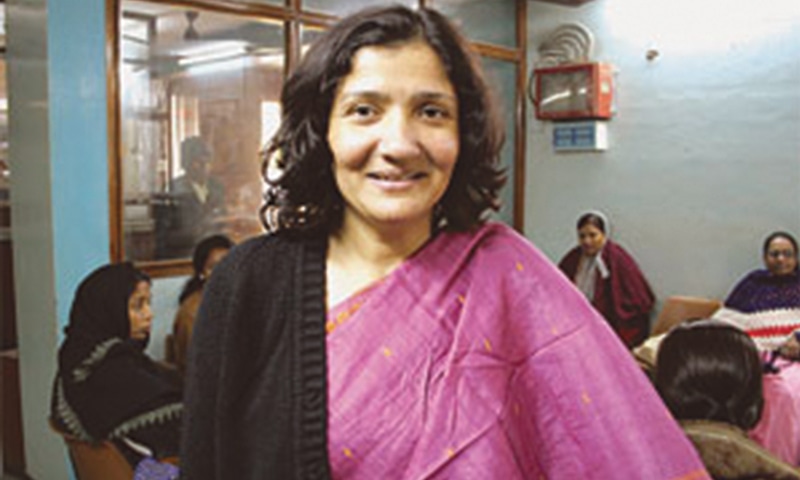

TWO women qazis of Jaipur, Afroze Begum and Jahan Ara, have broken the male-dominated bastion for the first time in Rajasthan. Whether they get to put their two-year training into practice is another story but if they do, it will be with a model nikahnama, a comprehensive legal document that has been prepared by the Bharatiya Muslim Mahila Andolan (BMMA) to help helpless women trapped in unfortunate circumstances.
Behind these confident and eloquent women qazis stands steely, gritty but soft-spoken Zakia Soman, co-founder of the BMMA, which now has over 70,000 members. Soman and a colleague, Noorjehan Niaz, are spearheading a silent social revolution in the backward Muslim community to stand up against injustice, gender parity and to voice their opinion in a highly patriarchal community.
Soman herself passed through a similar experience during the riots of 2002 in Gujarat. She and her then 13-year-old son had to flee their home in Ahmedabad and relocate to a Muslim ghetto on the outskirts. Stories of arson, looting, rampage and destruction shook her up. She wondered at the police’s insolence and their eagerness to let off the mischief-makers. For her, it was a harsh lesson in citizenship. Once the riots subsided, Soman began to visit camps to help with the rehabilitation programme. There she met many women, who despite coming from a poor background, wanted justice for their families. It changed Soman’s outlook and inspired her. It was then she realised the vulnerability of being a woman and a minority. But it failed to dampen her fiery spirit, She resolved to find a way to help these women who needed justice and a voice. Excerpts from an interview:
What is this model nikahnama that you say should be used by qazis, especially women qazis?
In Islam, marriage is a social contract. But traditionally, there are no details in the nikahnama other than just name and signature. There are only basic details. The model nikahnama has the terms of agreement written down during the time of marriage. It has details and declarations like whether the groom is married or not, death certificate, of previous wives, talaq (divorce) certificate, amount of mehr, which is the money given to a bride at the time of a wedding and is equal to 100 per cent of the groom’s annual income. The gifts received from both sides should be listed in the nikahnama. There would be two witnesses and their addresses, signatures, IDs on the nikahnama. It is a comprehensive, valid legal document and would be beneficial for both bride and groom in the long run, if the couple has problems later in their marriage.
But how do you enforce that couples get married with this nikahnama?
It would be a long-term process to enforce it. In 2009, we prepared the first version of the model nikahnama. It was used in some marriages and some mass marriages in Maharashtra and Gujarat. In Ahmedabad, a girl got a mehr of INR 100,000 with this nikahnama. The process to enforce it would begin with spreading awareness about it. There would be campaigns to make parents of the bride know about the details to be filled in the nikahnama. Qazis have cleared their two-year training course from the Mumbai-based Darul Uloom-i-Nisawa and they would use it. Many of our girls and even boys have developed a progressive mindset. We have hopes that more and more people will adopt this nikahnama during the marriage vows.
But what about a nod from the highest Muslim body for these qazis to practise?
It is not that everybody in our community will be against women qazis. There are some progressive qazis as well who interpret religion rightly. So we would talk to them and get them to share our model nikahnama among the masses. There is no authorised body in our community to give the go ahead for either women qazis or the model nikahnama.
The Muslim Personal Law Board is actually an NGO among the many thousand NGOs in our country. It has no judicial or official status. The mainstream media has got it wrong that it is one of our highest decision-making bodies. But our Muslim society is changing, there is awareness and the mindset is changing. Boys and girls are becoming progressive, more aware and knowledgeable that Islam is being interpreted by many in a wrong way. That section of our society is likely to believe in our nikahnama and would use it.
Is there still a lot of confusion between Sharia laws and the laws of the land? Is there a wide gap between the two?
The confusion is deliberate. Our society is still patriarchal and the confusion is to their advantage. In 1937, the British who ruled over India said Muslims would be ruled according to Sharia laws. But those laws do not talk about what should be the age of marriage, the ways of talaq and many other things. It is not a codified law. So everybody has the liberty to interpret laws in their own ways, especially the fundamentalists. The Quran has given women equal rights but it has not reached the poorest of the poor women yet.
Are you against triple talaq?
Our movement has strongly campaigned for abolishing the practice of triple talaq, which allows Muslim men to divorce a woman by merely saying the word talaq thrice. Instead, we want the use of the “talaq-e-ahsan” method, where at least four attempts at reconciliation are made before a divorce is granted. So comprehensive reform in Muslim laws is very necessary. The Quran had given us rights 1,400 years ago but we have not been able to savour it. In 2014, the BMMA drafted a Muslim Personal Law drawn from the Quran, but from a woman’s perspective.
—The Statesman / India
Published in Dawn, February 24th, 2016