 NAJAF, March 29: Four US soldiers died on Saturday when a man driving a taxi set off a bomb at a US roadblock near Najaf, southern Iraq, making it the first suicide attack since the United States invaded Iraq.
The bombing followed a pattern in which Iraqi forces, mainly militiamen loyal to President Saddam Hussein, have dressed as civilians to launch attacks.
Baghdad said the suicide bomber was a military officer seeking to teach the Americans. Eleven US servicemen had been killed in the incident, a spokesman said. He warned of more such attacks.
The bombing occurred when a man in a taxi drove up alone to a checkpoint on a desert road north of Najaf and “beckoned” US soldiers over to him, US Army Colonel Will Grimsley said.
“As they (soldiers) approached, he detonated the bomb, killing himself and four soldiers,” Colonel Grimsley said. There were no other casualties, he added.
Iraqi state television later identified the bomber as a non-commissioned officer, Ali Jaafar Musa Hammadi al-Numani, who wanted to “teach the invaders a lesson in the same manner of our Palestinian martyrdom fighters” who have carried out suicide attacks against Israel.
“This is a blessed start. The enemies will face steadfastness, courage and martyrdom’s souls,” it warned, adding that the attack also left “two armoured personnel carriers destroyed and two tanks damaged”.
Describing the attack, the television said that “after kissing the holy Quran”, Numani “drove a booby-trapped car toward enemy tanks and armoured personnel at the outskirts of Najaf”.
“He turned himself, his car and the explosives that he was carrying into a destruction missile by exploding himself,” it said.
President Saddam Hussein decided to award the soldier two top posthumous medals of honour, including the decoration of Umm al Maarik, or the Mothers of All Battles, as Baghdad calls the 1991 war.
Iraqi Vice President Taha Yassin Ramadan later added: “This is only a beginning and you will hear good news in the coming days. We will use any means to stop the enemy and kill the enemy.
“The whole Iraqi people, including its women, will transform themselves into Fedayeen (martyrdom fighters),” he vowed at a press conference in Baghdad.
The four confirmed deaths brought to six the number of soldiers killed in the US Third Infantry Division since the invasion began on March 20. One soldier was killed by an Iraqi while another died in a road accident.
Colonel Grimsley also said later that US forces opened fire and “destroyed” three other standard Iraqi orange-and-white taxis that ran US roadblocks in the same area and within the same 30-minute period.
There was no evidence the other cars were laden with explosives because they did not blow up when armoured Bradley Fighting Vehicles blasted them with their heavy guns, the colonel said.
He did not say how many people died in the other taxis.
US forces, which must “strike a balance between helping Iraqi civilians and protecting” themselves, will now have to behave more strictly at checkpoints, he added.
US officials have been expressing growing frustration over how to fight an “enemy which hides among a civilian population” they want to win over or keep on their side.
Iraqi fighters switch from uniforms to civilian clothes at will while launching attacks from “sites that US forces are reluctant to hit for fear of harming civilians”, an official said.
Major John Altman, a US intelligence official, had warned before the suicide bombing occurred that US forces might face the Fedayeen paramilitary group’s “White Ninjas” male and female suicide bombers, as they march toward Baghdad.
ANOTHER ASSAULT:Meanwhile, US-led forces mounted one of their fiercest air assaults yet on Baghdad on Saturday, targeting the centre and outskirts of the city with repeated bombings that drew blasts of Iraqi anti-aircraft fire.
The new attacks followed a Friday night strike on Iraq’s information ministry and a marketplace blast that killed 55 civilians.
Fierce attacks beginning on Saturday afternoon also targeted Baghdad’s outlying areas where Iraq’s Republican Guard are believed to be dug in to defend the capital against advancing US-led forces.
“There has been very heavy bombardment to the south and to the west. It seems unprecedented,” an eyewitness said.
“It is clear this is a major bombing campaign. The thuds of explosions just don’t stop.”
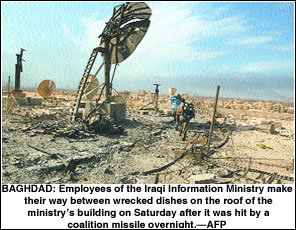
On Saturday morning, reporters found the information ministry compound littered with shattered glass and mangled filing cabinets and office equipment.
A missile appeared to have pierced the roof of the main 11-storey building, and aerials and satellite dishes on the roof were broken.
A ministry annexe that houses the offices of several media organizations was also damaged.
A US Central Command statement said Tomahawk cruise missiles had targeted the ministry building, but that an official assessment of the damage was not yet available.
US officials have said they are targeting communications facilities in an effort to prevent President Saddam Hussein from controlling the country and his armed forces.
Previous raids have struck television facilities close to the information ministry and elsewhere. Iraq’s international satellite television channel went off the air on Friday evening, but on Saturday both the satellite channel and domestic network were on the air.
DEATH TOLL: An Iraqi official said on Saturday the death toll from Friday’s bombing on a Baghdad market had risen to 68 dead and 55 injured.
At US Central Command headquarters in Qatar, Maj-Gen Victor Renuart said at a news conference the incident was under investigation.
“It is a tragedy when civilians are killed. We are looking at targets that may have caused something like that,” he said.
Renuart said an investigation of Wednesday’s blast, in which 14 civilians were killed, was almost complete. “We want to make sure that if there is an error we will find that out and...if it was carried out by an Iraqi system,” he said.
Residents in Baghdad said eight people had died in a raid on Friday on an office of the Baath party.
US defence officials said a B-2 stealth bomber had dropped two 2,086-kg bombs — known as “bunker-busters” — on a communications centre in downtown Baghdad on Friday.
The raids knocked out many telephone lines — some of the first bombing damage to civilian infrastructure.—AFP/Reuters