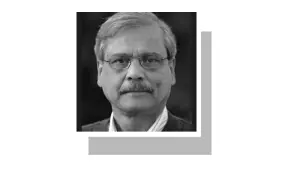
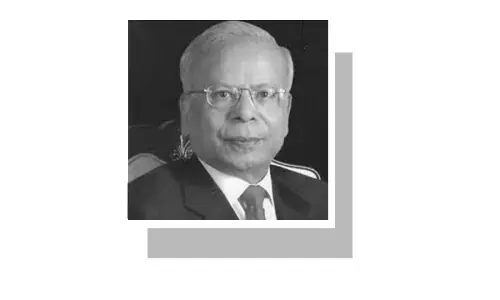
HAKIM Ali Zardari, who died on Tuesday, nursed dreams of making a name in politics since an early age. But he started out in life by proving his mettle in business, parlaying his success later into the dicey world of politics.
Born into a landlord family of Nawabshah district in 1930, Hakim Ali at first concentrated on farming, but could not keep himself aloof from politics for long as his family had close relations with some political families of Sindh, especially Nawabshah district. Prominent among them were the Syeds of Dabhro, Nawabshah, Bhirya Road and New Jatoi; Unars of Qazi Ahmad and Rajpars of Padidan.
During the late 1950s he decided to set himself up in business in Karachi. He opted for the world of showbiz, beginning with the city’s landmark Bambino cinema, the Scala and a film distribution centre.
But Hakim Ali Zardari knew his biggest passion was politics. He immersed himself in the local as well as the national scene around the late 1950s. The lucky break, however, came when the charismatic Zulfikar Ali Bhutto founded the Pakistan People’s Party in 1967.
Bhutto’s slogan of “Roti, kapra aur makan” (food, clothing and shelter) attracted the masses. People from all walks of life started joining the new party. Nawabshah district saw several political families embrace Bhutto’s populism and Hakim Ali was among the first to do so.
He won the PPP ticket for the 1970 general election and won a seat in the National Assembly.
During Mr Bhutto’s premiership Mr Zardari worked as head of the Public Accounts Committee. After Gen Ziaul Haq usurped power in 1977, Hakim Ali devoted himself to managing his business and keeping the PPP intact. After the execution of Z.A. Bhutto, he also looked after the estate of the Bhutto family, especially when Benazir and Nusrat Bhutto were in jail or in exile.
In 1987 Asif Ali Zardari, Hakim’s son, married Benazir Bhutto. It remains one of the most publicised marriages in the country’s history.
A year later general elections were held after the death of Gen Ziaul Haq. Mr Hakim Ali was awarded a ticket for the National Assembly and won easily. He retained his seat in the 1993 elections.
During Benazir Bhutto’s first term as prime minister (Dec 1988-Aug 1990), he was again appointed chairman of the Public Accounts Committee. When the combined opposition brought a no-confidence motion against Ms Bhutto on Nov 1, 1989, the Zardaris played a decisive role in defeating the move.
But the elder Zardari was not immune from the allegations of sleaze that eventually brought down the Benazir government. The National Accountability Bureau (NAB) filed a reference accusing Hakim Zardari of buying a house in Normandy, France, for 724 million dollars.
The bureau contended that as this amount was beyond Mr Hakim Ali’s “known sources of income”, it must have come from “hidden sources”. On July 11, 2002, the accountability court sentenced Mr Zardari to five years of rigorous imprisonment, a fine of 18.5 million rupees and disqualified him from holding any elected office for 10 years. On health grounds he was confined to his house, which was declared as a sub-jail. He was later released on bail.
He moved the Sindh High Court for relief, which after a long, testing process that ended on Jan 24, 2007, overturned his conviction by the accountability court, upholding his plea that he had a huge business in insurance and cinema to raise the resources for buying the house in France. He also faced an identical case in Lahore where an accountability court convicted him of making shady transactions with various organisations for establishing a tourist village at Rawalpindi National Park through Zardari Group (pvt).
He was sentenced to 18 months in jail and asked to pay a fine of 20 million rupees. On May 11, 2002, the Lahore High Court appellate branch ordered his release, saying that audit reports showed no such adverse remarks in transactions by the Zardari group.
Hakim Ali proved himself to be a man of iron will -- succeeding in business against all odds and distinguishing himself in the cutthroat world of politics.