0
0

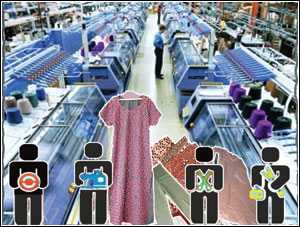 Apparel manufacturing is a labour-intensive industry, which employs 700,000 persons and relies more on the skills of individual workers. The growth of this sector is very important for employment and export earnings.
Garment industry consists of a large number of small and medium sized firms sandwiched between the two giants — big textile firms that sell yarn/raw fabric and the mega-sized retailers who buy the finished product. The size discrepancy means the small, family-owned garment firms have little negotiating power in setting prices; garment firms are “price takers.” And as such, these firms are unusually sensitive to costs, particularly that of labour which is by far their largest expense.
It is hard for them to offer their workers benefits and better wages. Added to that, mega-retailers have introduced marketing changes such as “lean retailing”— the practice of holding low inventories and replenishing only items that sell well. Lean retailing enables retailers to showcase eight or more fashion “seasons” a year great for them but which puts enormous pressure on small and medium manufacturers to adjust to frequent style changes.
Human resource: The traditional mode of garment production relies on using cheap labour, rather than seeking out more efficient technologies or improved production processes. With the changes in global sourcing patterns, the sector seem to be stuck in a low-skill, low-productivity mode of production rendering it unable to compete on the basis of cost with other producers such as China who pay their workers more wages.
The key criteria that affect the apparel sourcing decisions in the post-quota world are cost and availability of quality labour, which in turn, define the efficiency and flexibility of suppliers to meet changing fashions and retailer demands.
In order to be competitive in this ever demanding world of lean retailing, apparel industry needs to have an abundance of skilled, inexpensive, productive labour to remain competitive in a post-quota world. The cost and availability of a trained or trainable workforce are critical.
But low wage rates alone are not a good indicator of labour costs, as rates of productivity, which contribute to the cost of labour, is not among the best in the region. The effectiveness of middle management is also crucial, which has the responsibility for maintaining the reliability of product quality and supply, and ensuring the flexibility to change orders as needed. These are often cited as a weakness our apparel industry. This human resource issue has been addressed partially by the ministry of textiles through a scheme--Stitching Machine Operator Training Scheme (SMOT). Through the scheme, trainees are trained at selected factories to develop the skilled manpower for the industry.At present, 1200 candidates are being trained under the SMOT scheme at 35 different units as the first phase of the programme. The effectiveness of this approach is yet to be seen. However on the demand of the industry, the scheme has been extended to cover made-up sector as well.
Supply problem: One should not be misguided by the `stock reply’ offered by training models: if workers lack high-wage skills, train them, since better-trained workers improve productivity and draw higher earnings as well. One drawback of this approach is that it is not enough to train workers for garment/made-up sector jobs but the sectors themselves need retooling as much as workers need retraining.
This approach make workers job-ready but we also need to get industry itself for utilising entry-level workers at higher levels of productivity. To fully utilise talents of their workforce, firms must establish the proper environment including restructuring of the organisations and their incentives, appropriate designed jobs, and proper tools to measure performance. The first is a supply-side effort, while the second a demand side initiative.
A worker’s skill deficiency is not always the fundamental problem. Skill-deficiency problem is just one aspect of what really is a system-level problem. It is true that garment workers needed training in a broader array of skills to become more versatile on the production floor and qualify for a larger range of jobs.
But there was little point in training workers for a stagnating sector that would not leverage their full capabilities nor is able to pay them what they are really worth. The solution to the sector’s crisis needs to be a total package, of which employee training is just one aspect. Imparting training in conventional way without co-ordinating it with demand-side change would result in a frustrating waste of resources.
Many firms require external help to recognise the productivity benefits of paying new workers more and production processes to take advantage of their new skills. When such recognition fails, the result is an ongoing loss-loss situation. This is where the demand side approach comes in i.e. creating industry changes by persuading the firms to replace/restructure low-paying, unstable jobs by doing things such as reorganising their management practices or production processes.
Systemic approach: There is a need to adopt an integrated, systemic view of the entire industry using a novel approach that has since come to be known as the sectoral method. The industry itself needs to be restructured and repositioned. Apparel firms had to make major attitudinal shifts and organisational changes if the sector has to recover. Owners needed to be encouraged to invest in new machinery to realise production efficiency. They needed to replace old production techniques and learn to see and use workers in new ways. The sector’s comparative advantages needed to be carefully reanalysed. And new market niches and business alliances have to be fully exploited.
Dismantling attitudinal barriers is a change initiative that requires single-sector attention from an institution because it is a complex process that requires confronting seemingly irrational beliefs.
Systematic interventions raises the effectiveness of job training by coordinating it with industry restructuring, helping a sector reorganise and reposition itself in ways that increase its demand for better-paid, better trained workers. The intensive demonstration and information brokering services will help garment companies re-think their relationships to their workers and their markets.