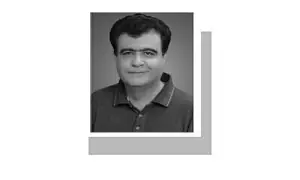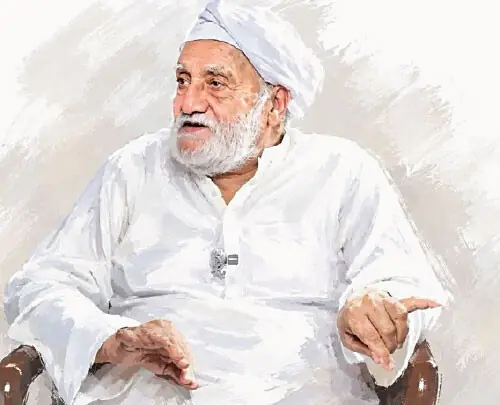
PESHAWAR: Saadullah Jan Barq, a veteran Pashto and Urdu writer, has recently come back into the limelight as his books, which were previously gathering dust in regional bookstores, are suddenly in great demand.
This resurgence of interest follows his provocative views about the genealogy of Pakhtuns, which he shared during his recent appearance on podcast ‘Facts are Facts’, hosted by Awami National Party president Aimal Wali Khan.
The viral discourse, which featured a detailed joint panel with Prof Hanif Khalil, has sent readers scrambling for past research, breathing new life into a vast literary catalog spanning six decades.
Confirming this sudden surge, Ayaz Tarakzai, the owner of a local Pashto bookstore, told this scribe that demand for Mr Barq’s books reached unprecedented level in the market. “The popularity of the podcast has not only brought Mr Barq’s research back into focus, but it has also helped to create a general rise in the readership of Pashto books across the board,” he said.
He said that young readers in particular were showing interest in regional literature.
Long before his views captured digital audiences, Mr Barq was a foundational pillar across Pashto and Urdu fiction, poetry, drama, journalism and cultural research. Emerging from the vibrant literary circles of Bannu in the late 1950s, he launched his prolific career with a collection of reformative short stories written in clean, unpretentious prose designed to challenge harmful societal customs.
Over a creative journey producing more than 49 volumes, Mr Barq’s poetic evolution has stood as a testament to his versatility. In sharp contrast to his public persona as a biting humorist, his serious ghazals reveal an artist of deep humility, emotional restraint, and structural mastery across complex rhythmic meters.
Concurrently, his separate collections of satirical poetry cement his reputation as a premier wit, capable of exposing systemic exploitation and human folly through sharp and accessible verse that resonates with common man.
Mr Barq’s media legacy is equally foundational to the region’s cultural fabric. As a broadcast pioneer for Radio Pakistan and television, he wrote critically acclaimed dramas and introduced popular comedic skits to regional broadcasting through long-running serials that successfully blended sharp social realism with an innate sense of situational timing.
In journalism, Mr Barq elevated Urdu satirical column to a distinct art form. His long-running newspaper commentaries are celebrated for their immense multi-linguistic richness, seamlessly weaving Arabic, Persian, Hindi, and Sanskrit expressions into daily political and social critiques.
In his later years, Mr Barq transitioned towards the deeply investigative and unconventional non-fiction prose that is driving today’s bookstore demand. His massive, comprehensive autobiography serves as an exhaustive historical archive of his literary era, mapping the social transformations of his homeland. As an ethnologist and historian, his specialised texts boldly challenge orthodox Western and regional historiography.
He argues instead for a deeply indigenous origin of Pakhtuns through a meticulous study of regional dialects and linguistic etymology – the very concepts that triggered his recent podcast revival alongside Prof Khalil. Furthermore, his philosophical treatises represent a rare, ambitious attempt within Pashto literature to harmonise classical Sufi metaphysics with modern evolutionary theory and cosmological physics.
Ultimately, Mr Barq’s creative output is defined by a unique synthesis of accessible, populist language and profound scholarly ambition. Whether through a biting newspaper column, a television script, or a controversial historical text, his pen remains entirely dedicated to intellectual provocation and intense social empathy, securing his place as an incomparable force in the regional literary landscape.
Published in Dawn, July 20th, 2026