0
0

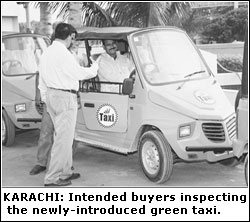 KARACHI, July 13: As the Sindh government has imposed a ban on registration of two-stroke rickshaws from this month, a motorcycle maker plans to launch four-stroke CNG rickshaw while a car-maker has already introduced a CNG-fitted cab to fetch its share in the transformation of transport culture in the province.
Currently, over 50,000 two-stroke rickshaws, which create both noise and air pollution, are ruling the congested streets of this mega city.
Haji M.Younus Pirani, chairman N.J. Auto Industries Private Limited, told Dawn that his company was launching four-stroke CNG powered auto rickshaws on Friday for the first time in Sindh.
The company, which is already producing motorcycles in Hub, Balochistan, has invested Rs600 million for the production of two-wheeler and CNG rickshaws. The plant has the capacity to roll out 2,500 units per month.
He said the CNG rickshaw would cost only Rs1.10 paisa per km and was likely to lure people from all ethnic backgrounds and not only Pukhtoons who dominate transport sector in Karachi. The price of rickshaw has been fixed at Rs125,000.
The CNG project, which was launched in technical collaboration with Italy and China, has created 130 new jobs out of total 400 jobs including in the motorcycle manufacturing unit. Mr Pirani claimed that the rickshaw had 75pc localised parts while the rest was imported.
“We plan to sell 1,000 rickshaws per month in Karachi,” he said ,adding there will also be leasing facility available for the buyers through various banks.
He said that the Punjab government had provided patronage to some assemblers of rickshaws. “If the Sindh government provides support to the company by introducing some kind of schemes for the youth we will change the market scenario in just one year by replacing the aging 50,000 rickshaws in Karachi,” he added.
However, he urged the government to include CNG rickshaws in the Rozgar Scheme announced last month through National Bank of Pakistan (NBP).
Transmission Motor Company (TMC) has introduced green taxi in the name of Alif Motor Cab in which the provincial government has been providing a helping hand.
TMC Chief Executive Officer Fasih Hussain Agha told Dawn the green taxi was fitted with CNG at a price of Rs200,500 with 200cc four-stroke engine. It was launched last month.
“The company has invested Rs45 million in the project and it is rolling out both cars and taxi in collaboration with China,” he said, adding that the deletion level has been achieved at 70pc as compared to 67.8pc when the project was launched last year.
“We want to give an option to the people between the rickshaw and taxi. Demand has arrived and so far 18-20 taxis have been registered with the Sindh government,” he claimed.
He said that the company had exported eight taxis to Sudan a month back while more orders were pouring in from various countries.
City District Government Karachi EDO Mohammad Athar told Dawn that the Sindh government had no plan to completely phase out over 50,000 two-stroke rickshaws.
The Sindh Transport Department had been providing an option to the manufacturers of two-stroke rickshaws to make some modification by converting them into four-stroke by June 2007 in order to control emission of smoke and noise.
“There is no restriction for the people to convert their two-stroke rickshaws into CNG only with four stroke engine. They can maintain the rickshaw even at petrol consumption but with four stroke engine,” Mr Athar said. He added that the registration of two-stroke rickshaws had already been banned from July 1, 2006.
On green taxi, he said the response from people had been cool so far as the new product would take time in building a confidence among the prospective buyers.
On the Rozgar Scheme launched by the federal government last month for transport, communication and utility stores, he said that so far there had been no interaction with the city government.
It may be mentioned here that majority of two-stroke rickshaw owners have converted their rickshaws on liquefied petroleum gas (LPG) following massive jump in petrol prices from Rs33.81 in June 2001 to Rs57.87 per litre. despite the fact that the government had imposed a ban on using LPG in the automobiles.
In absence of any check in the LPG price by the regulatory authority, some dealers and even the marketing companies enjoy a complete monopoly in manoeuvring the prices irrespective of demand and supply system. As a result, the rickshaw owners charge higher fares on the pretext that they are getting LPG at higher rates.