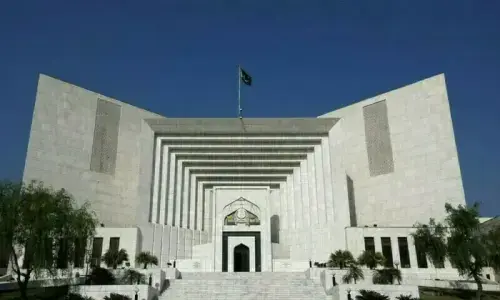
ISLAMABAD: The Supreme Court’s Shariat appellate bench on Monday sought assistance on a government appeal concerning the scope of the president’s and governors’ powers to grant pardon, remission or suspension of sentences after the enforcement of the qisas and diyat laws.
The five-judge appellate bench took up the federal government appeal against a 1991 judgement of the Federal Shariat Court (FSC).
Headed by Justice Jamal Khan Mandokhail, the bench comprised Justice Shahid Waheed, Justice Irfan Saadat Khan, Justice Dr Khalid Masood and Justice Dr Qibla Ayaz.
In its 1991 verdict, the FSC had declared Sections 401, 402, 402-A and 402-B of the Criminal Procedure Code (CrPC) repugnant to the injunctions of Islam, holding that these provisions conferred broad, unqualified powers of remission and commutation without subordination to Shari’ah. The judgement arose from a petition filed by the late Habibul Wahab Alkhairi challenging provisions that empower the president and provincial governments to suspend, remit or commute sentences.
Shariat appellate bench takes up govt appeal against 1991 FSC ruling restricting remission and commutation powers
The FSC in its ruling held that the provisions conferred substantive rights and powers and directed the federal and provincial governments to amend the law to specify that such powers could be exercised only in cases relating to Haqq Allah and punishable under Ta’zir, and only in the public interest as guided by Shari’ah.
However, it did not examine Article 45 of the Constitution, noting that it lacked jurisdiction to strike down constitutional provisions.
The FSC ruled that while the state may remit sentences for Ta’zir offences, the power is not absolute and cannot extend to Hadd or Qisas offences, where the right of punishment vests in God or the victim, respectively. The provisions were declared void unless amended to reflect these principles, with a deadline of Jan 1, 1992.
The federal government challenged the FSC ruling before the Shariat appel-late bench, arguing that remission and commutation are procedural matters and that retaining these powers serves the public interest. Deputy Attorney General Raja Shafqat Abbasi represented the federal government.
During Monday’s hearing, Justice Dr Khalid Masood observed that Islamic law recognises two categories of punishment: those explicitly prescribed in the Holy Quran and Ta’zir, where a Qazi determines punishment based on circumstances and evidence.
Justice Mandokhail questioned how a convict could seek pardon from the government for a sentence awarded by a court, asking what role would remain for the judiciary if the state could routinely remit or pardon sentences. He also cautioned that allowing parties to a case to seek state clemency could adversely affect society.
“If a person’s house is robbed, he approaches the state for redress,” he observed, adding that the complainant would be left remediless if the state were to later withdraw the case against the accused on its own.
However, the judge clarified that the bench would not seek an opinion from the Council of Islamic Ideology (CII), observing that it would not be appropriate if the court were to disagree with an opinion rendered by a constitutional institution.
Later, the bench issued notices to the provincial governments, including the Advocate General Islamabad, directing them to assist and present their respec-tive opinions.
Although the proceedings were adjourned to the first week of April, Justice Mandokhail made it clear that upon resumption, the court would hear the matter on a day-to-day basis.
Published in Dawn, March 3rd, 2026