0
0

The government has expressed satisfaction with Pakistan’s participation in the World Economic Forum (WEF), claiming it was more impactful than ever in projecting a positive national image and facilitating engagement with global leaders, development partners and prospective investors.
Hopping from one crisis to the next, Pakistan has nonetheless attended the annual gathering with notable regularity for decades. Successive governments, democratic and otherwise, have advanced similar claims, yet a durable growth trajectory has remained elusive and meaningful progress on human development indicators has been modest at best. What tangible outcomes substantiate the Shehbaz Sharif government’s assertion that this time is different, and whether these engagements will translate into measurable economic and political gains, remains an open question.
Risk-weary business leaders largely dismiss the WEF as a non-event. Unimpressed by the government’s self-congratulatory tone, they remain focused on their bottom lines, watching instead for signs that the authorities succeeded in persuading the International Monetary Fund to allow tax relief and concessions seen as necessary to sustain industry, spur investment and lift GDP growth. To broaden appeal for such support, many frame their own business expansion as integral to poverty reduction and job creation.
Preoccupied with meeting basic needs and shaken by recurring, often avoidable tragedies, ordinary Pakistanis hardly register an event unfolding in a distant and unfamiliar setting. Government pronouncements are largely perceived as rhetorical. What matters to them is their lived reality here and now; any potential benefits, mediated through a complex web of policies and global linkages, are too remote and intangible for them to readily comprehend or trust.
As the government celebrates its participation in the international forum, risk-weary business leaders largely dismiss the WEF, choosing instead to focus on their bottom lines
Last month, the global elite convened at the Alpine resort of Davos, Switzerland, for the 56th annual meeting of the WEF, seeking to interpret a rapidly shifting world where collective wisdom often struggles to keep pace with unfolding events. Five core themes shaped deliberations: cooperation in a more contested world, unlocking new sources of growth, investing in people, responsibly scaling innovation and building prosperity within planetary boundaries.
The gathering, which brings together heads of state, senior policymakers, corporate executives, and leaders of international organisations, serves as a platform for debating pressing economic, political, and social challenges. Yet, despite the prominence of emerging technologies and transformative forces, their long-term trajectory and implications remain only partially understood, leaving even seasoned participants searching for clarity.
Setting aside the grand themes and intellectual debates of global thinkers, Pakistan, like many other developing nations, approached the form primarily as a stage for visibility and relevance. It sought to capitalise on the opportunity to project itself as a credible investment destination and a responsible emerging economy ready to contribute to collective global efforts, rather than a fragile state teetering on the edge, burdened by entrenched challenges and a vast pool of disenchanted citizens.
Commenting on the outcomes of Pakistan’s engagement at the WEF, an analyst flagged the opacity surrounding its total cost. “Participation in such forums is known to be expensive. Without clarity on the spending, it is difficult to assess whether the exercise delivered commensurate value,” he said, requesting anonymity.
Attempts to obtain even an approximate estimate of expenditures, or a complete list of the official delegation, including the support staff, normally drawn from multiple European missions to facilitate high-level meetings, yielded no response from the relevant ministries or the cabinet members.
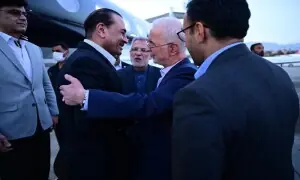
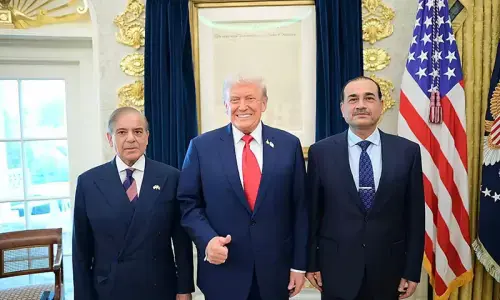
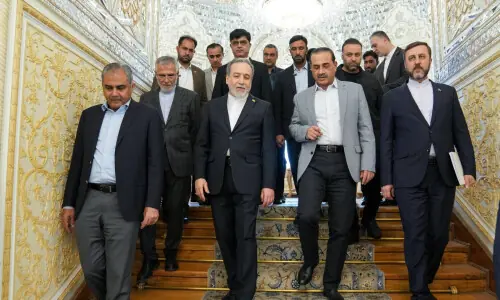
Beyond the prime minister, deputy prime minister, finance minister, PPP chairperson and Army Chief Field Marshal Syed Asim Munir, several senior bureaucrats and corporate leaders were also present. However, there is little transparency on how the costs were shared and what proportion, if any, was privately funded.
Former Pakistan representative at the World Trade Organisation, Dr Manzoor Ahmed, defended the government’s participation, pointing to the visibility it generated. “Participation in the WEF serves the national interest. It provides the prime minister and senior ministers an opportunity to engage directly with their counterparts and leading corporate figures, and to present a narrative of a Pakistan that is changing for the better,” he said.
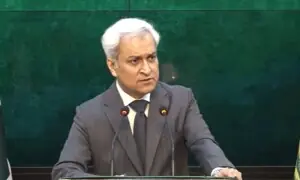
Khurram Schehzad, advisor to the finance minister, expressed confidence that Pakistan’s global perception is improving, with discussions increasingly centred on reforms, investment pipelines, and growth potential. He cited stronger macroeconomic indicators: GDP growth reached 3.09 per cent in FY25 and 3.71pc in Q1 FY26; inflation fell to about 4.5pc; and reserves rose to $16.1 billion. Pakistan recorded another fiscal primary surplus, while remittances hit a record and tech exports posted double digit growth.
The credibility of reforms has strengthened, with tax-to-GDP ratio at a 25-year high and public debt declining. Falling interest rates are expected to unlock private credit. These gains, he stated, enabled more substantive engagements with regional partners, shifting the focus from short-term support to long-term investment and economic cooperation.
Published in Dawn, The Business and Finance Weekly, February 2nd, 2026