0
0
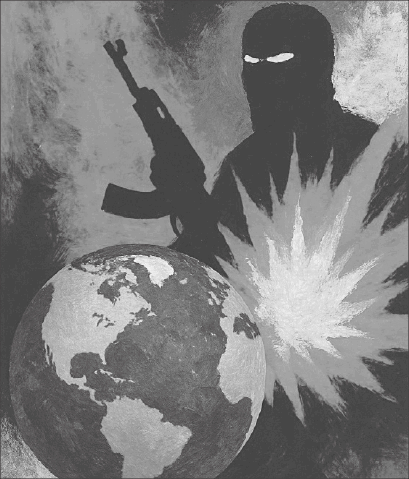
TERRORISM, in every guise and in every corner of the world, stands as a repudiation of the shared concept of humanity. No civilisation, no religion and no moral code sanctions the taking of innocent lives. To link this evil to any faith is to misread both history and reality.
Terrorism has neither a single home nor a single face; it is an affliction that has struck schools in Pakistan, concerts in Europe, shopping centres in the United States, homes in Gaza, and public spaces regardless of geography. The pain it inflicts is universal, and so must be the condemnation it receives.
Pakistan’s experience with terrorism has been particularly acute. Over the last two decades, the country has lost more than 70,000 lives — both civilians and security personnel — and has suffered economic losses estimated in hundreds of billions of dollars. Development in many regions has been delayed by years.
No city or town has been left untouched by the violence of extremist groups. This sustained assault reflects a deliberate and calculated strategy to weaken Pakistan from within, and malign it internationally.
Pakistan has consistently presented evidence to the global community about the origins of these attacks. Yet, while sympathetic statements have been issued in response, concrete action against
the perpetrators or their sponsors has remained largely absent. Diplomatic caution, geopolitical alliances and economic interests have too often overshadowed moral responsibility.
The pattern becomes even clearer when major events take place across Pakistan. Whenever foreign sports teams visit — cricket tours being the most visible example — terrorist attempts emerge with suspicious coordination. Years of such manipulation have revealed a strategic intent; to keep Pakistan unstable, isolated and under pressure.
In response, Pakistan has taken difficult internal steps, including the repatriation of Afghans living illegally within its borders. This was not an impulsive decision, but one rooted in national security concerns and the international principle that undocumented residents must eventually regularise their status or return home.
While Pakistan acted firmly but lawfully, India exploited this moment of regional tension to escalate disinformation campaigns and support anti-Pakistan activities through covert channels. Instead of addressing the root causes, the inter-
national system has largely confined itself to verbal regrets. The consequences of this global inaction are now becoming increasingly evident outside our region as well, underlining the undeniable truth; instability cannot be contained within geographical borders.
If the international community continues to dismiss Pakistan’s concerns while reacting only when violence reaches major Western cities, the global fight against terrorism will remain fragmented and ineffective. Terrorism is not an issue of selective vigilance; it requires collective responsibility and uniform action grounded in justice, not geopolitics.
What the world today needs is a serious, structured and enforceable agenda on counterterrorism. There must be an international conversation — one grounded in transparency — about proxy warfare, state-sponsored militancy, and the financial networks that sustain extremist groups. All countries that use terrorism as an instrument of foreign policy must be named, confronted and sanctioned.
Pakistan’s position in this regard has remained principled and consistent. The world must now recognise that Pakistan’s fight is part of a larger struggle in which every nation across the globe has a stake. Terrorism anywhere is a threat everywhere.
Muhammad Mohsin Iqbal
Islamabad
Published in Dawn, December 5th, 2025