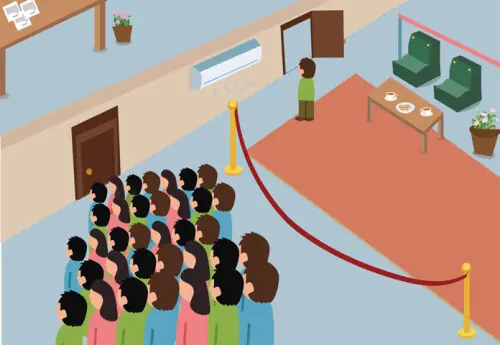
The Titanic was a magnificent luxury passenger ship that sank in 1912 after hitting an iceberg. Its first class section had luxurious suites, servants, French cuisine, private decks and a ballroom with an orchestra. The second class was comfortable but not luxurious, while the third class passengers, most of whom were seeking a new life in America, were housed on the lowest level, with simple food and shared cabins. Yet, they all faced the same fear and the same death in the icy waters of the Atlantic.
The Titanic has since become a metaphor for human society. Some see it as an indictment of human hubris, others reflect on the class divisions and the unequal value of human lives between the privileged and the poor. One can move the telescope further away and look at the inequality of nations — divided between the highly developed and those much lower down the rung.
Yet, every so often, nature makes short work of such differences. Celebrity homes were gutted alongside those of poorer residents in forest fires that raged across Los Angeles earlier this year. The covid pandemic did not see bank balances when it took over seven million lives — of which America and Europe accounted for 2.5 million. Climatologists warn that all nations will be affected by climate change, regardless of whether they are industrialised or not.
Developed and underdeveloped nations have been tumbled around much like the passengers of the Titanic. Poverty and homelessness continues to grow in rich countries. Nations that prided themselves on free speech, such as the US and UK, are cracking down on dissent, much like the dictatorships that they, till recently, reviled.
Across history, seafaring has become a literal and metaphorical symbol of both human vulnerability and adventure
The civil rights activist Martin Luther King Jr said, “We all came in on different ships, but we’re all in the same boat now.” Meanwhile, the English author G.K. Chesterton had quipped, “We’re all in the same boat, and we’re all seasick.”
The notion of vulnerable humans embarking on a journey with little more than a vessel between them and the unknown dangers of the open seas has a breathtaking magnificence. Whether in simple canoes that enabled early humans to island-hop in the South China Sea, or in the massive steel container ships of today, traversing the world’s oceans and journeys across seas have symbolised the adventure and heroism of man confronting nature. Viking warriors who died in battle were placed on a boat that was set ablaze. In Greek mythology, Charon the ferryman took the souls of the dead by boat into the Underworld.
Everyday language is peppered with nautical terms. We are told to ‘not rock the boat’, we wait for ‘a favourable wind’, someone can take the ‘wind out of our sails’, we ‘change course’, and we may find ‘our ship has sailed.’ We can be ‘rudderless in life’, abandon a cause by jumping ship’, we can be ‘the rat escaping the sinking ship’ or be ‘left high-and-dry.’ We face ‘choppy waters’ and ‘the perfect storm.’ We can feel ‘under the weather’, ‘lost at sea’, find ourselves ‘in the doldrums’ or ‘between the devil and the deep blue sea.’ We ‘learn the ropes’, ‘batten down the hatches’ and learn to ‘run a tight ship.’ We ‘tide someone over’, are ‘taken aback’, or are asked to ‘pipe down.’ And we look for a ‘safe harbour to drop anchor.’
Navigating the vast oceans symbolised freedom from the restrictions of society. Allama Iqbal wrote: “Bandagi mein ghut ke reh jati hai ek ju-i-kam-aab/ Aur aazadi mein bahr-i-beykaraa’n hai zindagi [In bondage, life is a stagnant pool of water/ In freedom, it is a boundless ocean].”
Sindbad’s entertaining adventures by ship are a main feature of A Thousand and One Nights. In Buddhism, the ship symbolises adventurism motivated by greed, and history shows that controlling the seas was pivotal for the expansion of colonialism.
However, the ship has also been the saviour of humankind. All civilisations have myths of a great flood, where humanity was saved by boarding a ship. In Abrahamic religions, Noah built an ark. In Hindu texts, Manu builds a giant boat. In Zoroastrian myths, one man survives in an ark with his cattle. In Greek mythology, Zeus punishes man with a great flood and Prometheus advises his son to build an ark.
In the distressing turmoil of mindless violence and moral vacuum, one may be excused for waiting for another salvation. More realistically, as the Soviet leader Mikhail Gorbachev put it, “We are all passengers aboard one ship, the Earth, and we must not allow it to be wrecked. There will be no second Noah’s Ark.”
Published in Dawn, EOS, November 23rd, 2025