Saifullah is 10 years old. When his employer — a long-haul truck driver named Bilal — is “in the mood”, the boy says he has no choice but to comply.
Bilal has worked out of Mauripur Truck Stand for three decades, hauling freight across Pakistan’s national highway network. In that time, he has “kept” a succession of young boys as apprentices. Saifullah is the latest.
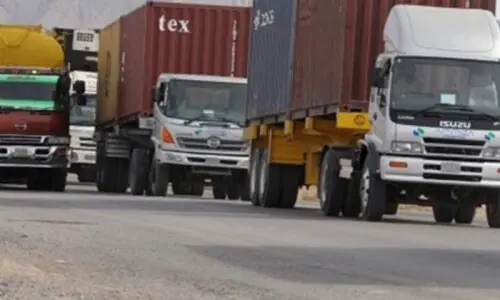
Sprawling across a hundred acres in western Karachi, the Mauripur stand pulses with diesel fumes and the blare of air horns during peak hours. Trucks bound for routes across Sindh and beyond the province idle between runs. But transport is not the only business conducted here.
A CULTURE OF ABUSE
Within the alleys and repair bays, an entrenched culture of exploitation persists. Child apprentices such as Saifullah become trapped in cycles of underage labour, physical violence and sexual abuse — a pattern child protection advocates say is endemic yet rarely prosecuted.
Wazir, 12, is another of Bilal’s boys. He works under the truck’s mechanic, learning to repair engines and change tires. Both boys clean the cab, fetch tools and perform odd jobs that justify their presence. The work earns them a seat in the truck for long-haul journeys — and keeps them within reach.
Beyond the diesel fumes of Pakistan’s largest truck stand, an entrenched system preys on vulnerable boys. Despite laws against child abuse and prostitution, a culture of complicity allows the exploitation to continue unchecked
The abuse extends beyond individual perpetrators. Multiple drivers at Mauripur engage in similar exploitation, the boys say, and sometimes share access to each other’s apprentices.
Saifullah says refusal brings retaliation — beatings with whatever tool that is at hand. He comes from a family situation he describes only as “troubled” and has nowhere else to go. The daily wage keeps him here. “The rest is just part of the work,” he tells Eos.
It is, by his own assessment, trading one unbearable situation for another.
DEPENDENCY AND GROOMING
An informal, small-scale inquiry conducted by the writer at Karachi’s Mauripur truck stand revealed a recurring theme through anecdotal accounts. A significant number of drivers informally suggested that relationships with young male apprentices served as their primary form of recreation.
Many of these drivers, like Bilal, framed this practice as a necessary compulsion, citing the isolation of long-haul routes and separation from their families. They consistently maintained the relationships were consensual.
However, these same informal discussions suggested a more complex dynamic, indicating that many apprentices, often coming from strained family backgrounds, may perceive these relationships as a source of needed affection and loyalty, complicating the drivers’ narrative of mere necessity.
This sense of a special bond is often reinforced through small, symbolic gestures. For instance, it was noted that apprentices frequently wore the same perfume as their driver, treating it as something unique they shared.
For instance, Saifullah wears a stone ring on his index finger, given to him by Bilal. While it is a size too big, he has adjusted it to his liking and shows it off with great pride. Such gestures appear to help cultivate an intimacy that deepens the driver-apprentice relationship.
This bond, however, often marks the start of a pseudo parent-child relationship, rooted in a painful trauma bond. According to clinical psychologist Dr Tahira Yousaf, this is a powerful attachment where the child, already financially dependent, becomes emotionally dependent on their exploiter. This dynamic makes escape difficult.
THE HIERARCHY OF POWER
Saifullah’s story is a case in point. He came to Karachi from a village in Sindh to financially support his ill father back home. Bilal offered him work and shelter, but the arrangement quickly turned sinister. Within a week, Saifullah was raped and forced into prostitution. Although the first weeks were terrifying, Bilal controlled every aspect of his life — from his food to his contact with family. For Saifullah, there was no way out.
This established relationship creates a rigid hierarchy. The driver holds all the control, while the apprentice, lured by vulnerability, becomes trapped. As these boys mature and wish to escape their exploitation, they find it nearly impossible. Their perceived masculinity within the community is tied to their sexual role; being on the “receiving end” marks them as weak and strips them of authority.
Furthermore, drivers weaponise personal information, threatening to expose the boys to their families and communities if they ever refuse or try to flee. As one apprentice explains, this threat of societal rejection is a powerful tool to ensure compliance.
For some, a degree of acceptance emerges. Wazir complies for the extra money, using it to buy personal items such as sandals. He rationalises the situation as a transactional arrangement, a less painful mindset than acknowledging the abuse and exploitation. When asked if he misses home, he tells Eos, “After what happens here, how can you go home?”
Some boys even frame the statutory rape to be consensual and voluntary, citing both financial gain and personal pleasure. As Saifullah notes, “It’s not a one-way road.” However, this self-justification is one of the most insidious aspects of the phenomenon, as it leads them to see themselves as willing participants rather than victims, thereby preventing them from seeking help or recognising their own abuse.
THE INSTITUTIONAL BLIND EYE
This distorted perception is compounded by systemic failure. While laws like the 2017 Sindh Prohibition of Employment of Children Bill criminalise child prostitution with severe penalties, enforcement is virtually non-existent in areas like Mauripur.
The sexual nature of driver-apprentice relationships is normalised within the trucking community, leading police to turn a blind eye. The boys are often mistaken for family members, deflecting suspicion. It is wilful ignorance, as the culture is well-documented, yet authorities remain complacent, leaving the boys without protection.
A further layer of exploitation is chemical dependency. The trucking environment normalises substance use, with drivers using drugs such as hashish and methamphetamine, locally known as ‘ice’, to stay alert on long journeys. Apprentices are exposed to these substances, along with alcohol, further cementing their dependence.
This culminates in a severe public health crisis. Unprotected sex is the norm, with one estimate — from a study published in the Culture, Health and Sexuality journal in 2014 — suggesting only eight percent of truckers use condoms. A profound lack of awareness about HIV and other sexually transmitted infections (STI) is pervasive. Bilal, for instance, believes his faith protects him from “Western evils.”
As Dr Yousaf states, without open conversation about these practices, the cycle of exploitation and escalating health risks will continue unchecked.
The writer is a freelance journalist currently pursuing a degree at the Institute of Business Administration, Karachi. He can be contacted at m.rehman.26317@khi.iba.edu.pk
Published in Dawn, EOS, October 19th, 2025