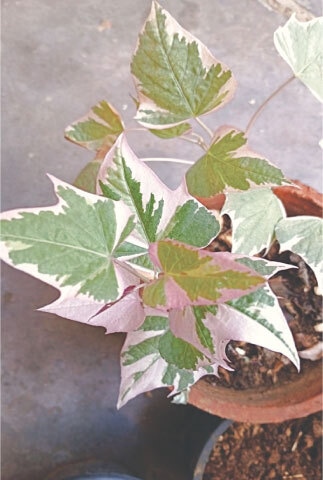
The Pink Frost sweet potato vine is a celebrated ornamental plant, prized for its stunning foliage rather than any edible yield. Its heart-shaped or deeply lobed leaves are a vibrant tapestry of pink, green and creamy white, creating a tri-coloured effect that adds a dramatic splash of colour to any space. It is also easy to find for a reasonable price at most nurseries.
Growing and propagating a Pink Frost vine is comparatively easy if its basic needs for sun, water and well-drained soil are met. A vigorous but manageable grower, the Pink Frost vine thrives in sun to partial shade and is perfectly suited for containers, hanging baskets and garden borders.
However, one must follow certain basic steps and take some precautions to ensure the plant’s uninterrupted healthy growth. For instance, like other plants, the Pink Frost vine is susceptible to attacks by pests, insects and diseases.
The plant also requires a basic watering and light regimen. Sometimes, in their eagerness to make the Pink Frost vine bushy and full of foliage, gardeners can inadvertently limit plant aeration. This happens due to clustering, which refers to the dense grouping of leaves, stems or branches, creating a thick mass of foliage. Overlapping is the direct consequence, where these clustered leaves layer on top of one another.
Prized for its tri-coloured leaves, the Pink Frost vine is easy to grow but susceptible to fungal diseases from overwatering and poor airflow
These phenomena turn the plant’s own lush growth against itself, by preventing the leaves from drying properly and allowing pathogens to spread easily from one leaf to the next, resulting in fungal infections and other leaf-related diseases. Hence, it is essential for the leaves to be spread out, with enough airflow in between.
Similarly, excessive watering and water pockets on the soil surface can also cause fungal infections. Any infected leaf, which can be identified through characteristic brownish-black spots, should be pruned and removed as soon as possible. Then, treat the plant with a commercial fungicide, following the manufacturer’s instructions carefully until the infection clears.
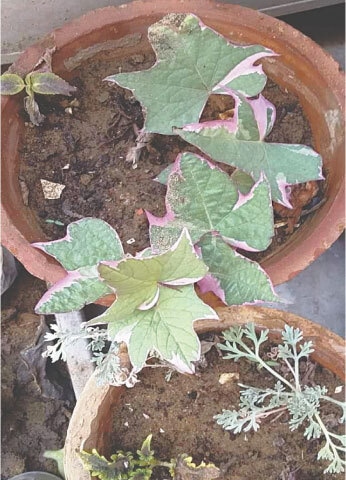
One of the most common diseases found in the Pink Frost is root-rot, which is primarily due to excessive watering or inadequate water drainage. The characteristic feature of this disease is the wilting of the leaves, which obstructs the beauty of the dual-coloured leaves. One may come across swelled-up stems and mushy roots having a bad odour in such cases. The swelled-up stems should be pruned and removed. The stems that are still healthy can be replanted in a better soil-mix medium, with adherence to a proper watering schedule.

If root-rot is detected early, there is no need to panic. The affected parts of stems and branches can simply be cut off and removed. Even if the main root system is compromised, healthy stems still in contact with the soil can often root from their nodes and form new plants.
Powdery mildew is another common disease of the Pink Frost vine, which is typified by curling leaves having white powder over them. It can be controlled with better aeration, usage of different organic sprays and removal of the affected leaves. Affected leaves should be destroyed and should not be placed in the compost bin!
To address the above-mentioned fungal concerns and ensure a thriving Pink Frost sweet potato vine, it is critical that the correct watering schedule and quantity is ensured. The plant should be watered enough so that the soil is moist, and not wet. Water deeply, but allow the top layer of soil to dry out between waterings. Watering in the early morning is best, as evening watering leaves foliage damp overnight and encourages disease.
Please send your queries and emails to doctree101@hotmail.com. The writer is a physician and a host for the YouTube channel ‘DocTree Gardening’ promoting organic kitchen gardening
Published in Dawn, EOS, October 19th, 2025