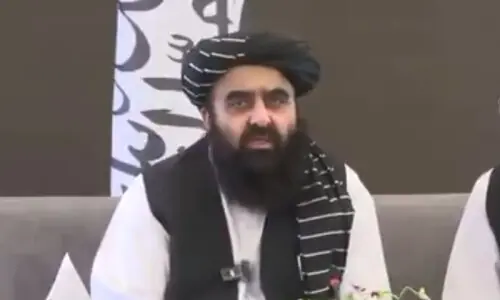
INDIA’S pact last week for upgraded ties with Afghanistan’s Taliban rulers has been seen mostly as an act of befriending the enemy of the enemy, an implied reference to the worsening tensions between Kabul and Islamabad. The slow-cooked but warm reception accorded to the Afghan foreign minister in New Delhi — which officially still doesn’t recognise the Taliban government — and the ensuing unsubtle statements from both sides set off an angry reaction from Islamabad. It was followed by military action on the Afghan border that’s said to have been linked to the events in Delhi.
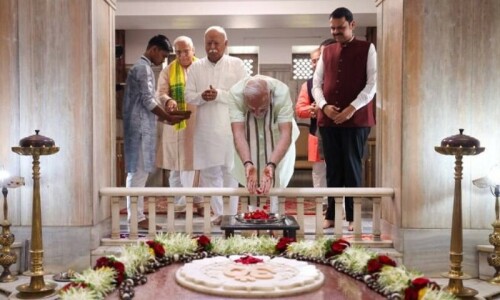
The pact, however, also coincided with an auspicious event for the Hindu right, the celebration of the hundredth year of the Hindu revivalist RSS in 2025. Marxists used a phrase that has since gone out of fashion, for the meeting of minds like that of the Taliban and the RSS. They called it unity in obscurantism.
In hindsight, there’s nothing terribly remarkable about this rapport. Possibly the warmest ties India ever had with Pakistan flourished when Gen Ziaul Haq was leading his country into a dark abyss masked in controversial laws and ordinances. And the man to sanctify Zia’s murder of democracy in Pakistan was an RSS veteran dressed as India’s foreign minister.
Atal Bihari Vajpayee, visiting Pakistan in 1978 after evicting Indira Gandhi from power over her brief suspension of democracy, lauded Zia’s ties with the Janata Party government, in which the RSS for the first time was a key player. Vajpayee studiously avoided petitioning Zia during the visit to spare Z.A. Bhutto’s life that world leaders were doing and Indira Gandhi had pleaded for despite her being out of power after a resounding defeat in the 1977 elections. In the event, Vajpayee’s prime minister in the 26-month long government, Morarji Desai, was honoured by the military dictator with Pakistan’s highest civilian award. No Indian government has equalled the bonhomie.
In another time zone, in his decade-old cultivation of leaders abroad, one such encounter was missed for its irony: Prime Minister Modi’s happy mingling with leaders of Uzbekistan. As it turned out, Uzbekistan is where historical characters like Zaheeruddin Babar and Taimur are celebrated as national heroes, even as they are reviled as villains by Hindu nationalists in India. In India, the preferred invective RSS followers carry for Indian Muslims is to call them ‘Babar ki aulaad’, progeny of the first Mughal emperor. (There, too, the RSS and Pakhtun leaders readily make common cause given their collective animus towards the Mughal rulers, particularly Babar.)
Much has been said about women journalists not being invited to the Afghan press conference by the Taliban foreign minister.
Yet, the leaders in Tashkent, on their part, could scarcely be distracted by the sectarian events the memory of one of their heroes had spawned in India. In a similarly contrarian context, the RSS, rightly or wrongly, accuses Indian Muslims of greater loyalty to Makkah and Madinah than to their own country. However, the crown princes, emirs and sheikhs from that part of the Arab world never seem to tire of visiting India or receiving Modi in their bear hugs. Another facet of ‘unity in obscurantism’ needs to be seen from a historical lens. It was not a coincidence that India’s Hindu and Muslim revivalist groups were both in jail during Indira Gandhi’s 1975-77 emergency.
Their bonhomie continued outside the prisons, across the borders. When Modi stopped over for an unannounced eyebrows-raising visit to Nawaz Sharif in Lahore, he was interestingly returning from Kabul. However, when another fellow RSS leader went soft on Pakistan, appreciating the liberalism and secularism he saw in Jinnah, and when L.K. Advani scribed a kindly message at the Quaid’s mausoleum in Karachi, all hell broke loose at the RSS headquarters. Advani was denounced and denied his bid to become prime minister. For the RSS, it was the case of Zia good, Jinnah bad.
Much has been said about women journalists not being invited to the Afghan press conference by Amir Khan Muttaqi, the Taliban foreign minister. Muttaqi changed the stance quickly, and there were reportedly more women than male journalists in his next press conference. What was overlooked in the bargain was a more curious fact, that the current prime minister of the world’s most populous democracy had neither invited a woman nor a man or any other to a press conference he hasn’t ever held. This is not to make light of the barbaric treatment the Taliban regime reserves for its women, however.
Kabul used to be a fashion hub in South Asia, materially and spiritually in harmony with itself. When middle-class women in northern India or Pakistan were struggling with dress codes, and movie heroines danced around trees to song sequences draped in dupattas, women in Kabul were going to the university dressed in smart skirts they often brought from the latest collections of Parisian stylists. India’s classical music wizard Vilayat Khan would play the sitar at the court of King Zahir Shah. Likewise, Afghanistan’s Mohammed Sarhang was feted in India as a masterly singer of Persian poetry and Indian ragas.
Be that as it may, the treatment of women in India by religious puritans is not something the Taliban would frown on. The madressahs of Deoband that inspire the Taliban worldview could exchange notes with Hindutva groups come Valentine’s Day or some such. Their shared disapproval of women carrying cellphones, wearing jeans or mixing with men to celebrate an event targeted them equally.
Consider how Madhav Sadashiv Golwalkar, regarded as the most consequential head of the RSS, believed women were misled by modernity. The Caravan magazine carried an in-depth report on the RSS to assess Modi’s three years in power in 2017. Citing a couplet that states that “a virtuous lady covers her body”, Golwalkar, according to Caravan, lamented that “‘modern’ women think that ‘modernism’ lies in exposing their body more and more to the public gaze. What a fall!” Take your pick.
The writer is Dawn’s correspondent in Delhi.
Published in Dawn, October 14th, 2025