Nostalgia and memory are emotionally charged and heavily loaded idealised narratives that stem from places we may have lost and places to which we return to search for them.
Sophia Balagamwala, in her works from her current oeuvre ‘Frog Rain’, which was on display at Karachi’s Canvas Gallery, managed to sidestep the more recent penchant for attaching derision to the exploratory and extraordinary experience of nostalgia that has come to be regarded as a variant of melancholia in the postmodern world. Balagamwala instead interprets it as a valuable, significant resource that may steady us and guide us through our latter lives.
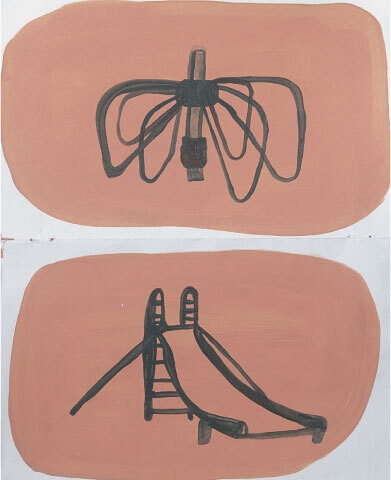
Balagamwala’s paintings are washes of paint in the most varied sizes, ranging from small pages of a notebook to large paintings on linen, a softer medium than tough canvas, yet traditionally used as frequently as canvas from the time of the Renaissance. The images are childlike and candid, simple and fluid in their execution. They look like quick, facile renderings of a child in an afternoon of languor.
But we know the monumental effort images such as these exact from the artist. When Pablo Picasso said, “It took me four years to paint like Raphael, but a lifetime to paint like a child”, he was not being flippant. The technique requires exhaustive learning, meticulousness, diligence and rigour — exercises that we as viewers notice readily in a miniature painting but ignore in other Modernist genres, such as abstraction or drip painting.
Sophia Balagamwala’s artworks manage to capture both a childlike wonder and a growing sense of isolation
The images are wonderful in their associations with childhood memories. Terrazzo flooring in homes, cast iron grills, concrete breeze blocks, concrete slides in a playground, aluminium merry-go-rounds and a child playing with a favourite toy are all shared fond recollections.
The title of the show is reminiscent of the myriads of little frogs that would appear frequently after rains and carpet driveways and gardens. There are references to precise locations as well, such as Hill Park and its pond of ducks, one of the few accessible parks that Karachiites were privy to at one point in history, and which has since become a sordid wasteland inhabited by felonious elements.
There are a few figures, almost polymorphic, in a sort of nebulous existence between reality and imagination, like a child’s imaginary friend — someone with whom to share life’s experiences, without having to define precisely what they look like or who they are. Then there’s an ephemeral sandman who may prompt any or all the emotive aspects of humour, dread, anxiety, comfort, vulnerability amazement or just curiosity.
Interestingly, the smaller works are placed at erratic levels of viewing — some very low, almost knee high, and some that require craning one’s neck to perceive lucidly. The variation may imply the act of looking and seeing through a child’s eye — at lower quadrants there’s a prospect of clarity. At a height, life seems distant and inaccessible, thus a hurry to grow up. The multimedia part of the show consists of mattresses placed in the quiet corners, on which the viewer is induced to take a few moments of respite from the madding crowd and, using the given headphones, listen to a rather awkwardly narrated, and resultantly unstilted, storytelling of times past and anecdotes of awe and wonder.
There’s an isolation in Balagamwala’s works that may not necessarily signify loneliness. Gabriel Garcia Marquez, in his novel Love in the Time of Cholera, says of the protagonist Florentino Ariza: “He was still too young to know that the heart’s memory eliminates the bad and magnifies the good, and that thanks to this artifice we manage to endure the burden of the past.” It’s a sifting of memory that is the natural order of both the heart and the mind.
The image of two children sitting side-by-side, perceptibly alone, may have been retained from an event in which there were several other kids playing in their presence. But the heart remembers that one companion who was beloved.
However, the playground objects on large linen canvases are decisively unattended and we can hear in our mind’s eye the squeaky movements of the merry-go-round spinning on its central axis by the push of the wind and not the force of a human hand. The idea is further reinforced by the artist’s statement in which she says:
“We have big rains now too but they are different The water is darker and angrier, or is that us”
The ambience is definitively dystopian — a surreal landscape that points to the environmental degradation we are experiencing and the losses we are enduring largely driven by human wastefulness and consumerism. Intense and extreme weather conditions, destruction of natural habitats and disruptions to agriculture have severely impacted human health and welfare, resulting in cascading effects of mass migration, increased conflict and breakdown in development.
All these factors can be imagined in the empty apocalyptic playgrounds of solitude that Balagamwala depicts. There are no children on the slides and in the parks, which were once oases of the concrete jungle. There are only quirky, idiosyncratic memories of people and places.
‘Frog Rain’ was on display at Canvas Gallery in Karachi from September 2- 11, 2025
The author is an independent art writer and curator
Published in Dawn, EOS, October 5th, 2025