ESSAY: DEATH HAS DIED IN GAZA



I have wagered, for some time now, that no one sets out declaring: I leave, therefore, to breathe. Who would dare? Where would such a lexicon be housed, what institution could archive it? For what is it, in our routine-ised world of repetitive motions, the countdown of habit — sites, scenes, errands — if not a desperate grazing after over-stimulation, some anesthetising jolt to offset the monotony?
Yet we never admit it. We drape our departures in the bureaucratese of duty, in the itineraries of conferences, workshops, friends, kin. Perhaps all people leave in order to breathe but, in Palestine, the phrase has become literal, almost idiomatic. It is our language, our shorthand. I am leaving to take a breath, but I will be back shortly.
One does not, perhaps cannot, say: I must go because settlers have thickened the atmosphere with enclosure, because the claustrophobia of fixity refuses to let up, because immobility has become intolerable. We leave because repetition makes us dizzy, because one’s own image, ceaselessly ricocheted back by the mirror of old acquaintances, grows unbearable.
The problem is not only their gaze but their refusal: their insistent no to the change you’ve risked or pretended to risk. They see only the static portrait, never the mutation, the faltering attempt to de-install oneself from the programme of sameness. And so the wager remains: one travels in order to breathe, while being forced to disavow the very air one seeks.
A Palestinian academic from the West Bank dwells on the guilt and shame of watching helplessly the destruction of his fellow Palestinians’ lives in Gaza, even as the world facilitates the genocide being perpetrated in Palestine by the occupying Zionist settler-colonial state
But leaving also carries with it the tremor of a question that won’t let go: will I be able to return? Not simply: will I catch the flight back, or find the keys still turning in the lock. But: will the door itself still exist, or will it have been quietly uninstalled in my absence, erased from the coordinates of place, or bombed out of existence?
For here, departure is never innocent. It never was. Each step outward is shadowed by the possibility of not stepping back in, by the terror that thresholds and doors held for us in Palestine — those fragile permissions of belonging — may have been redrafted or revoked while you were gone. Return is never guaranteed; it is administered. One does not come back on one’s own terms. The doors are policed by a figure who has already pre-scripted your exclusion, whose intent is bent on your erasure, whose very job description is to render your coming-back impossible.
And what will stop him? Nothing — not when the world itself, fatigued by our voices, weary of our insistence on surviving, tacitly shares his wish that we would disappear. Silence, complicity, exhaustion: these are his accomplices. That way, no one has to bear the shame, the awkwardness of watching your home burn, of seeing your life annulled, of confronting the wreckage of your predicament.
It is easier, perhaps even preferable, for this world if you were simply not there. Absence spares it the trouble of responsibility, relieves it of the burden of witnessing. To vanish is to absolve others of the awkwardness of having to look, to recognise, to answer.
This is why, each time one leaves, one wagers not only on air, not only on breath, but on the continued possibility of a place to which one might return — to re-enter, to reclaim, however precariously, the fact of dwelling. A wager staked on thresholds, on doors, on the fragile continuity of home. Yet it is a wager that may already have been lost in advance, annulled before it is made.
Let us vanish at once, then — so that the Arabs who cannot stand us, who confess to hating us, may at last be relieved of the headache, the stubborn residue we have become. So they can party with the Israelis, dance in the heavens of normalisation, free of our insistent demand. Let us vanish at once, so that the World… need not confront its truth, need not be dragged into the awkwardness of listening to the unbearable syllables we carry.
And yet — I have this friend, a serial leaver, gone every month, sometimes twice, as if rehearsing exile until it calcifies into routine. I tease him, half-seriously, that he has already emigrated, only he hasn’t filed the paperwork with himself yet. He looks well enough, even buoyant — though appearance, as we know, is only surface coding, a casing that withholds its cracks. The smile is a mask, the depths encrypted, unreadable without access keys.
What accumulates under these repeated departures? What fractures, what silent aches are folded into his itineraries, smuggled in the carry-on? To leave so often: is this freedom, a kind of self-administered flight training? Or is it the opposite: the symptom of a radical suffocation, the refusal — or failure — to breathe here? He goes, he returns. The doors still, for now, consent to open. Courage, then? Or only the cultivated art of withdrawal, an expertise in slipping away before the knot cinches tight?
Is he running toward or away? And does that distinction still hold, when place and displacement collapse into the same coordinates? He disappears, he reappears, a flicker. I catch him sometimes in Ramallah, body humming with transit, a little spectral, as if arrival itself had only been staged. Then — gone again. His comings and goings do not belong to him alone; they dramatise what conditions us all: never fully here, never safely elsewhere. Always in rehearsal for departure, forever uncertain of return.
It is this idea of vanishing that continues to haunt me — vanishing not as poetics of escape, not as some romantic fading into the ether, but as the stigma of being too unwanted, surplus to the world’s accounting. A pariah written out of the ledger of existence. A non-entity who nonetheless scandalises by insisting on language, by speaking when silence has already been assigned.
To vanish because survival itself becomes shameful — shame at having lived when others did not, shame at enduring what should not be endured. To vanish because rage corrodes the will to persist, because persistence begins to look like complicity in a world that remains immobile, indifferent, unbudging, even as the machinery of killing runs its course.
After all — why affirm life in such a world? Why transmit it? Why imagine children, continuity, lineage, when the promise of life has been so disfigured, so betrayed? To insist on life here risks sounding obscene, a parody of affirmation. And yet, to abandon life entirely — to let it vanish without residue — risks surrendering to the very script imposed by those who wish us to vanish.
But it is this vanishing — this rehearsal of disappearance — that lingers with me these days. The flirtation with dissolution, the temptation to slip out of frame, to erase the coordinates of recognition: to be without eyes, without ears, without the senses that condemn us to endure what must be endured, to bear what must be borne. To witness — always to witness — what devastates, and to feel, or fail to feel, the unbearable oscillation between affect and its suspension.
And yet, as too many of us discover, leaving is no deliverance. One never leaves the cargo behind. The body smuggles its own repetitions, the mind contraband of its own compulsions. One carries what one carries, endlessly replaying the tape.

But how does one vanish, exactly? Is vanishing ever a technique, a discipline rehearsed, or only a fantasy staged at the edges of exhaustion? And is there, scandalously, a beauty in vanishing? A secret comfort in withdrawal, in draping oneself with a vast blanket — large enough to cover three bodies at once, enfolding them into a shared oblivion?
There are days when the wish surfaces, obscene in its lucidity: that genocide would not be parcelled out in instalments, would not stagger its cruelty across the calendar, but arrive all at once — sudden, cataclysmic, a single bang. Then no hierarchy in death, no waiting your turn, no losing the beloved before losing yourself. Equality granted only at the edge of annihilation.
Isn’t this precisely the fantasy of the end inscribed in scripture? In the Qur’an, in the Bible: the Day of Judgement, the Rapture — always figured as an interval that is abrupt, condensed, catastrophic rather than stretched out. The suffering does not elongate itself indefinitely; it falls swiftly, totalising, in short bursts of apocalyptic time.
Even the words —Rapture, Judgement — announce the brevity of the interval. The cruelty is absolute, but not prolonged. Everyone gone in a single flash, equal at last. Equality deferred to annihilation. Wouldn’t that be something — something terrifying enough to be mistaken for comfort, or comforting enough to be terrifying? A wish that dares not speak, except under erasure, except as irony. Yet it hovers, persistent, the fantasy of vanishing together rather than alone, or one by one.
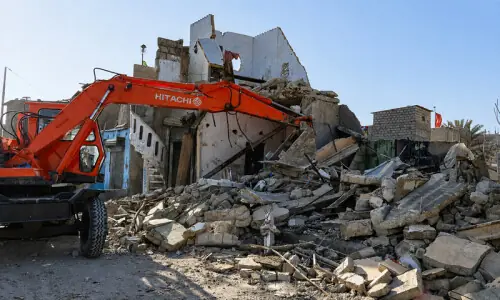
A friend from Gaza ends her message with a sentence I cannot dislodge: Don’t worry, soon you will not have to hear from us. As if silence were a gift, as if erasure could spare me the trouble of listening. I wish it were so easy — to imagine that the death of Palestine, the killing of its people, the rampage through its towns and orchards — might be solved with the mute button, excised like background noise, disavowed without residue.
Of course, she knew what she was saying, and what she was not saying. Her line was not resignation but rebuke: a sentence addressed to us in the West Bank, where paralysis masquerades as survival. Her words exposed our inability to act, to break ranks, to provoke the confrontation that might undo us, to resist. She wanted equality at least in death, destruction as common denominator, the dignity of perishing alongside the rest.
What could I answer? Nothing I could write, nothing I could perform with words, could reach her, could grant her the comfort she denied herself. I wanted to tell her: your life matters, your stories will endure, your sharp eye and dream of travel, of study, of breathing elsewhere — these are not erased, and hope remains. But the sentence she gave me — soon you will not have to hear from us — already sealed the conversation in advance.
The silence was prepared, the vanishing rehearsed and the acute sense of becoming a burden on the world, and a burden on the intimate other in Ramallah. And so I answered her with only one word, or rather, one sentence stripped to its bone: Don’t worry, we will vanish after you.
As if consolation could be forged from sequencing disappearance, as if comfort laid in promising that our erasure would follow theirs, obediently, belatedly, like the echo of a shot. What kind of comfort is that? A perverse solidarity, an inverted lullaby, a vow to keep faith in annihilation. But perhaps it was the only language left to me, the only syllables not already compromised, the only reply that did not sound like betrayal.
To speak of survival, of endurance, of futures — was impossible, almost obscene, in the face of her sentence. So I offered her this: the assurance that we, too, are rehearsing disappearance, that our vanishing will not fail to join hers. A promise of absence together, sequentially, one after another.
Yes — these are some of our conversations today. Not all, to be precise. There are others that lean stubbornly, sometimes absurdly, toward a world that could be otherwise. A world wagered in the subjunctive, stitched together from the fractured grammar of hope. Hope, even as it collapses under its own weight, even as it limps and stutters, even as it betrays us daily.
I confess: I am one of those who still insists. Not because I believe, exactly — belief is too naïve, too polished — but because refusal requires its own oxygen, its own lungs. To survive is to breathe not only air but the broken syllables of a future that refuses cancellation. Even when everything conspires toward vanishing, one clings to the possibility of an otherwise — if only in the ruins, if only in the interval before the mute button takes effect.
Indeed, we flirt — or perhaps more scandalously, we desire — the BANG. Who is this we, anyway? I hesitate even as I write it, since inclusion here is never innocent. But I have heard the lamentations scattered, like overheard debris: a mother, oscillating — always oscillating — between “let us leave” and the darker wish, whispered with a cruel lucidity, “perhaps they will kill us all.”
A taxi driver too, just recently, ferrying me on what was supposed to be a short trip, a brief errand. But brevity is a fiction in this landscape; hours dilate, sentences stretch, time itself is jammed. He muttered the same wager, as if under his breath but aimed at me nonetheless, testing whether I would echo or recoil. These refrains — half-confession, half-curse — keep circling. They enact their own relay: leave/stay, breathe/choke, vanish/insist. The BANG, as catastrophic fantasy, becomes the obscene shorthand for equality, for ending the staggered cruelty of instalments. But to name it — already one risks complicity with its seduction, with its strange allure.
Let us vanish at once, then — so that the Arabs who cannot stand us, who confess to hating us, may at last be relieved of the headache, the stubborn residue we have become. So they can party with the Israelis, dance in the heavens of normalisation, free of our insistent demand.
Let us vanish at once, so that the World — capital W — need not confront its truth, need not be dragged into the awkwardness of listening to the unbearable syllables we carry. So that Germany may rest assured: its underwriting of yet another genocide is not cruelty but courtesy, a favour granted to a people who themselves whispered: do it quickly, dispatch us without instalments. Thus even he is spared, unburdened of shame, re-secured in his historical ledger.
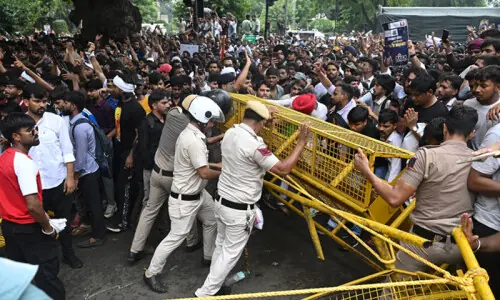
Let us vanish so governments may be excused from staging their clumsy theatre of democracy, no longer forced to arrest their own citizens while policing dissent. So headlines no longer stumble awkwardly over the word Palestine, choking as if on a stone lodged in the throat. Let us vanish without memory, without residue — so we will not become what our enemies have become, so our names cannot be instrumentalised in the slaughter of another. Let us vanish without a trace, so those who remain can go on, unburdened by the loss of Palestine, relieved even of mourning.
There is, perhaps, a perverse wish. Not the only one, but one that persists, lodged inside each of us like a shard. The collective death wish. It circulates quietly, disavowed in daylight, whispered in the margins. Not because we long for death exactly, but because death at least promises equality, a levelling when all else collapses into hierarchy and deferral.
It is perverse because it terrifies us while seducing us; because to articulate it risks complicity, risks sounding like surrender, even collaboration with the machinery that already scripts our erasure. Yet there it is, seated stubbornly in the body, refusing eviction. A wish that destruction, if it must come, would come for all at once — not parcelled, not staggered, not measured out in instalments. That our muteness would come as a relief, that it will wash all of our sins.
This is not the same as nihilism, nor is it the clean poetics of martyrdom. It is something murkier: a refusal of the world’s cruel prolongation of suffering, an impatience with its slow-motion genocidal theatre. A desire to collapse the unbearable waiting, to shorten the interval between loss and one’s own disappearance. A death wish, yes — but collective, almost utopian in its twisted way: that if we must vanish, we vanish together.
I know, I know — this swerves too dark, too indulgent in catastrophe, too unflinching in its acceptance of the triumph of the military machine. But then, where else to go? There is a light at the end of the tunnel, yes, though no one agrees whether it belongs to the oncoming train that will flatten us, or to the promised land we have been rehearsing. In either case — relief. (One learns to become promiscuous with relief, to welcome it in any form.)
A friend from Gaza condensed the matter with her crystalline cruelty: Here, Death has died. A sentence so unbearable it loops back into clarity, as if to say: what you call the end, we are already enduring.
The writer, also known by the pseudonym Abboud Hamayel, is a Palestinian intellectual and political analyst. He is currently Assistant Professor in the Philosophy and Cultural Studies Department at Birzeit University in the West Bank, Palestine
Republished with permission from the journal Communis.
The original piece can be accessed
here: https://communispress.com/
death-has-died-in-gaza/
Published in Dawn, EOS, September 28th, 2025