The Council of Islamic Ideology (CII) on Wednesday clarified that no final decision had been taken yet on the issue of withholding tax on money transfers and withdrawals after the body earlier declared it to be “un-Islamic”.
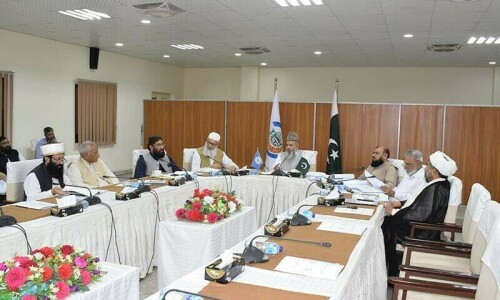
The CII made the earlier decision and others at its 243rd meeting today, presided over by CII Chairman Allama Dr Muhammad Raghib Hussain Naeemi, the press release read. “The council declared the withholding tax imposed on withdrawal or transfer of money as excessive and declared it un-Islamic,” the press release said.
As per the Federal Board of Revenue (FBR), withholding tax is an advance payment of tax deducted at the time of economic activities specified under certain sections of the Income Tax Ordinance, 2001 and Sales Tax Act, 1990.
However, a clarification issued later read: “Regarding today’s meeting of the CII, there was an impression that the council had formed a final opinion on the withholding tax, whereas in fact, a few members had an initial discussion on it, in which the members had different opinions. The members said that they would consult experts on this in the next meeting.
“Therefore, it was decided that in the upcoming meeting of the council, it should be discussed in detail and the opinions of the relevant experts should be sought. The council did not take any decision on the issue under discussion.”
As per the earlier press release, decisions were also taken on matters including components in insulin made from pork, the amendment of the diyat law (blood money) and keeping copies of the Holy Quran clean after they have been used for testimony.
“The council did not agree with the proposed amendment bill [to] the diyat law. The council is of the opinion that the Islamic amounts of diyat, namely gold, silver and camels, should remain included in the law, while the bill has deleted silver and made the un-Islamic amount of gold a standard,” the press release read.
Separately, the [CII] expressed reservations over the decision of a two-member bench of the Supreme Court on September 11, 2025, saying that “making iddah and maintenance mandatory for a non-consummated woman in the event of divorce is against the Quran and Sunnah”, the press release read.
In a landmark judgement, the Supreme Court ruled that a woman’s right to maintenance (Nafaqa) was neither contingent upon consummation or ‘Rukhsati’ (bridal departure) nor was it subject to her husband’s discretion.
Additionally, the CII declared that human milk storage institutions can be established under specific conditions, but noted that there needs to be mandatory legislation first, with the council included in the process, to “prevent corruption”.
At the request of the Ministry of Religious Affairs, the council also recommended that a ringtone should be developed that instructs citizens to respect flags and banners with holy words on them during the month of Rabbiul Awwal.