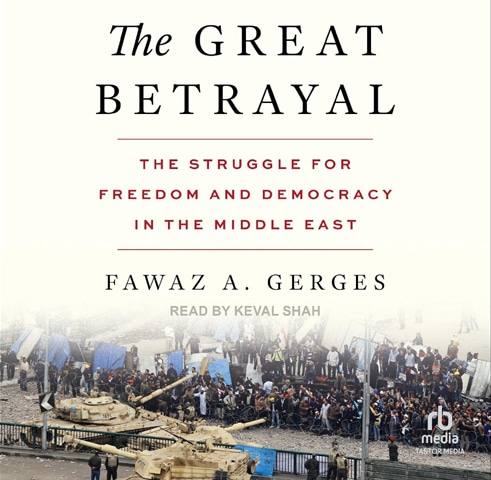
The Great Betrayal: The Struggle For Freedom and Democracy in the Middle East
By Fawaz A. Gerges
Princeton University Press
ISBN: 978-069117663-5
384pp.
The Middle East today is scarred by devastating wars, entrenched authoritarianism and fractured states. Citizens remain caught in cycles of violence, corruption and repression. Scholars have offered diverse explanations for these patterns, often attributing the turmoil either to the intervention of foreign powers or to the failure of domestic elites.
In The Great Betrayal: The Struggle For Freedom and Democracy in the Middle East, Lebanese-American professor of international relations at the London School of Economics and Political Science Fawaz Gerges emphasises that these factors were never separate, and their mutual dependence is central to understanding the region’s enduring instability.
The symbiotic interplay of external meddling and local rulers’ authoritarian proclivities foreclosed the emergence of a political identity transcending sectarian divisions, and gave rise to a recurring pattern of conflicts rooted in subnational loyalties. At the heart of this dynamic was the systematic exclusion of broader society from meaningful participation in decision-making.
The arrangements at the end of the First World War provided the earliest example of this pattern of exclusion. Arabs had hoped for an independent Arab state, but Britain and France subordinated these aspirations to their imperial ambitions, and imposed the mandate system instead of fulfilling wartime promises.
A recent book by a respected academic that traces the Middle East’s history from the colonial era to the present day in a clear analytical framework is both accessible and engaging
The emerging state order thus reflected the accommodation of colonial interests at the expense of popular demands, and it consequently lacked legitimacy. Colonial authorities empowered pliant local rulers to govern territories under the mandate system and institutionalised divisions that sowed the seeds of sectarian discord.
In Iraq, for example, the first Constitution of 1921 distinguished between “original” and “non-original” Iraqis, with the former defined as Ottoman subjects who did not claim any foreign citizenship. This categorisation relegated much of the Shia population, who were Persian subjects before the birth of the state of Iraq, to the status of second-class citizens. It institutionalised a suspicion of their loyalty and laid the groundwork for state discrimination. Thus, from the outset, foreign intervention combined with domestic governance to entrench a politics of exclusion across the Middle East.
The independence of Arab states after World War II seemed to open the possibility of constructing a political order grounded in popular will. Yet postcolonial leaders, including those at the helm of the Arab nationalist movement, built regimes that combined emancipatory rhetoric with authoritarian practices.
Crucially, these governments were sustained not only by their coercive capacities but also by the support of external patrons. From the mandate system to the post-independence period, outside powers consistently subordinated local aspirations to three strategic priorities: securing access to Gulf oil, guaranteeing Israel’s security and containing ideological rivals. Gerges argues that these imperatives ensured that popular will was repeatedly marginalised in favour of rulers who served foreign interests over their societies.
The surge of Arab nationalism — though marked by an illiberal character — held out a rare hope, attempting to transcend sectarian divisions by rallying people around the vision of pan-Arab solidarity. However, internal divisions undermined Arab nationalism’s capacity to deliver on its inclusive aspirations. Nasser in Egypt deployed Arab nationalism primarily as a strategic instrument against outside interference, while Iraqi and Syrian leaders advocated for a unitary Arab state.
The movement also fell prey to the personal ambitions of leaders. Radicals within the nationalist ranks criticised Nasser’s gradualist approach and questioned his revolutionary credentials. This critique prompted Nasser to demonstrate resolve by entering the Six-Day War against Israel, when his forces were already overstretched in Yemen. The ensuing defeat inflicted a devastating blow to Egypt’s leadership in the Middle East and weakened the secular forces of nationalism. Foreign powers capitalised on these failures and bolstered reactionary monarchies whose survival hinged on external protection.
Cold War politics further entrenched this mutual dependence. Western powers poured arms into the region to equip conservative ruling families as a bulwark against communism. These regimes, in turn, relied on foreign weapons and security guarantees to consolidate their rule, suppress domestic dissent and exclude ordinary citizens from political participation.
Beyond reinforcing autocratic governance, the Cold War patronage also spilled into regional rivalries. The influx of arms intensified inter-Arab rivalries, fuelling proxy conflicts such as the Egyptian-Saudi struggle in Yemen, which enhanced the reliance of authoritarian rulers on foreign powers.
Alongside external patronage, domestic governance in these countries was marked by corruption and economic mismanagement that further alienated the public. Leaders who promised liberation turned instead to policies that enriched a narrow elite while impoverishing the majority.
In Egypt, Anwar Sadat’s infitah [opening] aligned the economy with capitalism, but its benefits accrued mainly to politically connected businessmen and ruling families. Sadat’s half-brother, Esmaat al-Sadat, amassed a fortune of $150 million, while living standards for ordinary Egyptians stagnated or worsened. Across the region, similar patterns of the gulf between rulers and ruled fractured state-society relations and reinforced the exclusion of ordinary people from both political and economic life.
The erosion of the appeal of nationalism produced, in Gerges’ words, an “ideational vacuum.” Into this vacuum, Islamist groups and non-state actors rose to prominence. For Washington, the ideological imperative of containing communism made these groups valuable allies and they were cultivated as a religious counterweight to ‘godless’ communism. Local rulers also found them convenient tools to silence the liberal opposition.
This strategy, which appeared expedient during the Cold War, carried lasting consequences. By arming and legitimising Islamist movements, the United States and its allies fostered networks that later gave rise to Al-Qaeda. At the same time, authoritarian rulers used them to entrench exclusionary rule further.
The exclusion of ordinary people deepened when Arab rulers actively used the policy of divide and rule, which pitted communities against each other. Gerges notes: “While regimes in Iraq, Libya, Syria, Yemen and others officially advocated national unity, they simultaneously carried out informal policies that sustain sectarian, tribal, ethnic and other subnational identities.”
Where the domestic elite deployed these subnational identities as an instrument to divide the opposition, foreign powers propped up non-state actors to serve their geopolitical interests. Israel’s support for Hamas to counterbalance the PLO and US patronage of fragmented groups in Iraq are stark examples of such interventions that created new forms of instability.
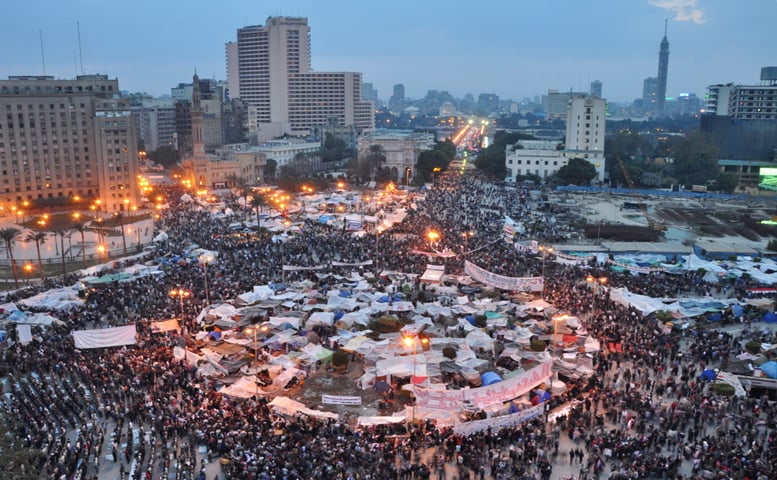
Amidst these dynamics, Gerges does not dismiss the capacity of people to act as agents of change. The Arab uprisings of 2011 represented a direct challenge to the established order. Citizens from across the social spectrum, transcending sectarian divides, asserted their political voice. This moment of collective mobilisation briefly opened the possibility of a more inclusive order. Yet the uprisings were brutally suppressed by authoritarian regimes or their gains were rolled back, often with foreign backing, as external powers prioritised continuity over reform.
Although Gerges remains optimistic about the potential of people to transform the old order, the resilience of the nexus between authoritarianism and foreign intervention underscores how difficult it is to break the cycle of exclusion and dismantle old power structures in the Middle East.
The book undertakes the complex task of tracing the Middle East’s history from the colonial era to the present day. Yet by organising this vast material within a clear analytical framework, Gerges makes the work both accessible and engaging to read.
The reviewer is an academic based in the UK.
He can be reached at naumanlawyer@gmail.com
Published in Dawn, Books & Authors, September 14th, 2025