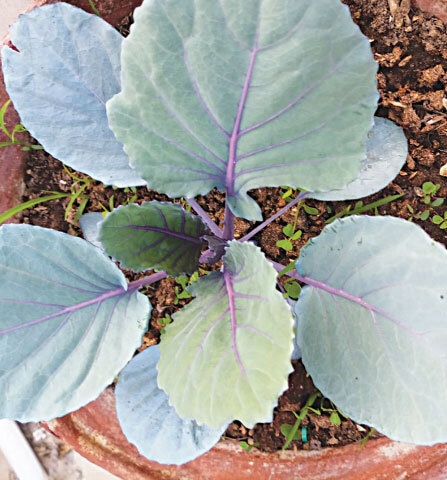
A red cabbage grows from a seed into a plant suitable for transplanting as a sapling within four to six weeks. Once it has turned into a sturdy young sapling, it is time to move to the next stage of the life cycle of this highly nutritious and heat-tolerant plant of the Brassicaceae family.
The segregated saplings can be further grown in two ways: one option is to grow the saplings in a separate, dedicated container, while the other is to simply grow it on a small ground patch or open space.
The minimum size of the container should be 10 inches in height and width to ensure a proper harvest. While the roots of the red cabbage plant may grow deep, the main spread of the roots is sideways. A container smaller than the minimum size will hamper the horizontal growth of roots, with the result being smaller cabbage head produce. Cylindrical pots instead of conical ones will provide greater space for the roots to spread, supporting and stabilising the cabbage produce overhead, and the availability and drainage of water from the soil.
When the saplings are planted in an open space, it is mandatory to keep a gap of at least one foot between saplings. This gives the plant enough space not only to grow bigger leaves, with a subsequent better leafy produce, but also enough aeration among leaves to discount any chances of fungal infections or diseases due to crowding.
Transplanting is a critical stage in the red cabbage life cycle, with container size and plant spacing key to optimal root growth
When planted in close proximity, there is a high chance that the leaves of the growing plants touch and overlap with each other. This contact between leaves not only inhibits growth, but it also enables disease and infection to spread from one leaf to another.
At this stage of the life cycle, the plant is watered on alternate days in colder areas, corresponding to zone 9 (average minimum winter temperature range of approximately -6.7 degree Celsius to -1.1 degree Celsius) or below. In warmer areas or those that experience harsh summers, like Karachi, the plant has to be watered daily.
The ultimate goal is to ensure that the soil remains moist throughout, but does not get wet. In case the soil turns wet or dry, the watering schedule should be adjusted accordingly, regardless of the growing conditions. This aspect is critical because one of the main reasons for a smaller cabbage head produce is the drastic changes in watering, which includes both over-watering, resulting in waterlogging of the soil, or under-watering, mimicking drought-like conditions.
Since cabbage is grown for its leaves rather than its flowers or fruit, its fertiliser needs are specific. The fertiliser should be rich in nitrogen and phosphorus. While nitrogen improves foliage growth and leaf size, phosphorus ensures stronger development of the roots, which benefits the plant in the longer run. The fertiliser should be applied every fortnight.
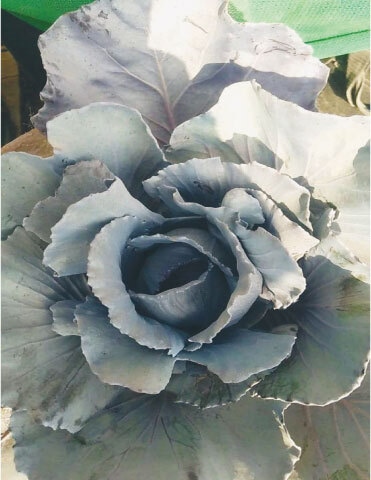
As the sapling starts to mature, the number of leaves increase and the plant begins to grow larger, full-sized leaves. At this stage, the colour of the red cabbage leaves is distinctively different from other plants. The outer larger leaves are greyish in colour. The intermittent colour change is visible in the smaller inner leaves near the stem, which turn to a shade of light purple. Soon enough, these leaves start to fold to form the cabbage head shape.
With the plant maturity phase in progress, there is a high chance that the plant may start to destabilise from the base due to the increase in weight and width. One trick is to heap up the soil around the plant base or the stem portion of the growing red cabbage plant. This accumulation of soil supports the heavy plant from falling off on either side. It also benefits the plant in watering, as the water seeps down from this heap and does not accumulate around the stem.

In the maturity phase, early morning sunlight exposure of five to six hours is the minimum requirement for the red cabbage plant. In the case of harsh sunlight or afternoon sunlight presence, the plant should be covered with a green net, to ensure only filtered sunlight reaches the plant.
Please send your queries and emails to doctree101@hotmail.com. The writer is a physician and a host for the YouTube channel ‘DocTree Gardening’ promoting organic kitchen gardening
Published in Dawn, EOS, September 14th, 2025