Blood moon eludes Karachi as thick clouds cover skies


KARACHI: Stargazers gathered at the Institute of Space Science and Technology (ISST) at Karachi University (KU) till late on Sunday evening for a rare celestial treat — a total lunar eclipse, also known as ‘blood moon’ — but a heavy cloud cover over the moon denied them the view despite access to powerful telescopes.
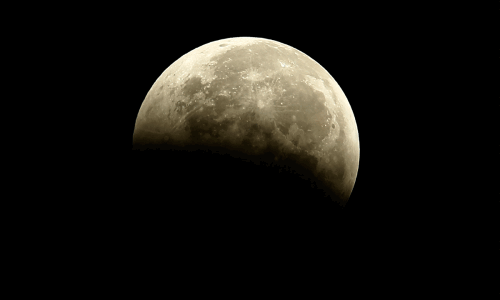
It was a total lunar eclipse that occurs when the Earth comes directly between the sun and the moon, casting its shadow across the lunar surface. And this eclipse was also known as a blood moon because of its reddish hue. Astronomers explain that this happens when the sun, Earth and moon line up and the shadow cast by the planet on the moon creates an eerie, deep red colour, something which has always astounded people.
Unlike solar eclipses, lunar eclipses are completely safe to observe with the naked eye, binoculars or telescopes. Therefore, the ISST remained open for people to come and witness the rare occurrence in the heavens. But only a few came.
The total lunar eclipse lasted from 10:31pm to 11:53pm, an exceptionally long time of 80 minutes. It was said that the long lasting eclipse was visible to billions of people across Asia, Africa, Australia and Europe though stargazers in Europe and Africa only got a brief chance to see a partial eclipse just as the moon rose during the early evening.
Citizens tune in to watch lunar eclipse as live streams broadcast rare celestial event
At the ISST, there was an eight-inch diameter Dobsonian telescope on the big terrace. There was also the 16-inch diameter Meades LX 200 telescope upstairs. But Fayyaz ur Rasheed, a senior lecturer at ISST, told Dawn that “even though both telescopes are strong with the upstairs one even stronger than the one below, still nothing beats the cloud cover”.
“We also knew that the clouds would hinder our view here so we did not call our students,” he said. “Otherwise, this place gets quite crowded. Still, even if we did manage to catch a glimpse it will be shared live on our Facebook page,” he added.
Meanwhile, young Anas, Alishba and Zoha, who had specially come to see the eclipse with their parents, looked disappointed. When the eldest child, Anas, exclaimed after focusing for a long while that he could see something, the others took brief turns to look also but they could not see anything. “The kid belongs with the Ruet-i-Hilal committee,” someone uttered, followed by giggles.
More families arrived and were left equally disappointed. Then Fauzia Rehan, a grandmother, who had come with her two daughters and their children, shared that she had witnessed a blood moon during her days at Ra’ana Liaquat Ali Khan Government College of Home Economics. “It was many years ago when we girls saw it from our hostel balcony,” she said.
“That evening there were also very strong winds blowing, and the other students got very scared at the sight of the red moon. They thought that it was doomsday. All ran inside screaming and crying,” the grandmother narrated.
General Manager Suparco, Zain Rahim, was also present at ISST on Sunday. In fact, the bigger telescope at ISST has been gifted to them by Suparco.
Mr Rahim called up their other centres in Islamabad, Gilgit, Multan, Sonmiani to know if they could see the eclipse. Quetta reported back saying that the skies there were clear and that they had a clean and clear view of the lunar eclipse. They were promptly issued orders to record the event at specific timings and send back the pictures.
Soon Anas Qureshi, another lecturer at ISST, connected their big LED screen to his laptop to view a website, www.timeanddate.com, which clearly showed the eclipse in real time. It slowly made the frowns go away.
Published in Dawn, September 8th, 2025