0
0

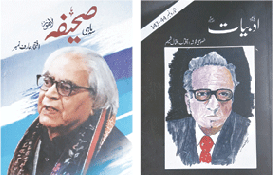
URDU magazines are in hot water: rising costs and dwindling sales have made the survival very difficult. Some of them have had to be adapted for the technological advances and these Urdu magazines are now sold online as well, with offering options for making payment online and receiving printed copies through mail or courier. The same goes true for Urdu books as many booksellers report that the traditional walk-in customers are becoming rarer by the day and those who do walk into the bookshops are mostly the aged ones as younger generation prefers to read online.
Some periodicals have decided to bring out, in addition to their usual printed copies, the digital versions. For instance, Urdu Adab and Hamari Zaban, the literary magazines published by Delhi’s Anjuman Taraqqi-e-Urdu Hind (ATUH), are printed and are also available at their website. Some others have completely gone digital and these magazines are available online only. Many Urdu magazines, especially the ones from India, are now sent to Pakistani readers and contributors electronically as the postal services between the two countries were suspended years ago. In some cases, the printed copies of Indian literary journals sent to Pakistan through postal services are routed through a third country.
But all is not lost and physically printed copies are still in much demand. Recently, for instance, Lahore’s World View Publishers reprinted Urdu Adab’s special issue on Mir Taqi Mir — originally published by ATUH — with permission, of course. This proves that the demand for physical copies is still there and it will take few more years, perhaps, for the digital copies to catch the fancy of readers across the board.
With Urdu’s literary magazines in survival mode, some other techniques have also been in place, for example, digital printing. As mentioned in these columns a few weeks ago, Urdu’s books and magazines are now produced on laser printers and it is possible to get the copies printed in small quantity, say 50 or even less. Produced according to the needs of a special albeit small segment of the market, it saves time and money and publishers can avoid the problem of unsold stocks, too.
But then there are some government-run literary organisations that publish their literary magazines. Following the old pattern, they get physical copies printed and send them through post, though most of the copies are sent gratis as literary magazines do not sell well at bookshops. For example, recently Majlis-i-Taraqqi-i-Adab, Lahore, published a special issue of Saheefa on Iftikhar Arif. Pakistan Academy of Letters, Islamabad, has just brought out a new issue of Adabiyaat, with a special section on Aftab Iqbal Shameem. And Quaid-i-Azam Library, Lahore, recently published the Silver Jubilee issue of Makhzan. Lahore’s Bazm-i-Iqbal also gets its magazine, named Iqbal, printed through traditional printing methods. No doubt, they are doing a good job, but sooner or later they will have to change their strategy.
It is noteworthy that some of these government-run entities have already adapted for the new technological change and copies of Makhzan, for instance, are not printed in large numbers as it is available online, free of cost, making it easy-to-access for the new, tech-savvy generation. Monthly Akhbar-i-Urdu, published by National Language Promotion Department (NLPD), too, is available online and though its print version is not brought out anymore, it can reach free of cost to a wider audience. NLPD would do well to restore the online availability of back issues of the magazine.
On the other hand, monthly Qaumi Zaban, published by Karachi’s Anjuman Taraqqi-i-Urdu, is regularly published, though printed digitally. Taking a cue from Karachi’s Anjuman and Lahore’s Quaid-i-Azam Library, NLPD should consider getting their magazine’s copies printed in smaller numbers, either digitally or otherwise. In this way, the record of print edition of the magazine, launched some 45 years ago, would be maintained.
As for Urdu research journals published by our universities, the Higher Education Commission (HEC) requires the universities to publish their research magazines online. As a result, most of these journals are first published online and later on copies are printed in small quantities. Of late, the Urdu department of Islamabad’s Allama Iqbal Open University first published its research journal Tabeer-i-Nau online and soon the printed copies followed. Latest issue of Bunyad, Urdu research journal published by Lahore University of Management Sciences, has recently been published online and hard copies may be on their way. On the contrary, Urdu research journals of several other universities have become tardy.
Published in Dawn, September 1st, 2025