0
0
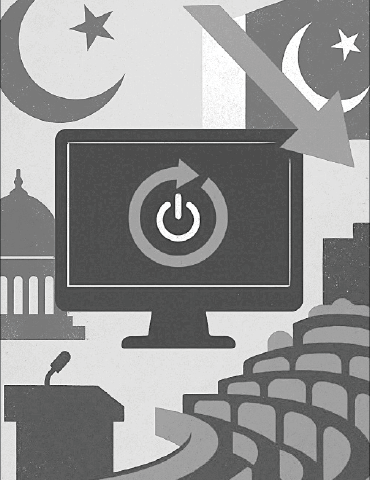
PAKISTAN’S democratic evolution in 2010, which aimed at empowering the provinces, improvnig service delivery and bringing governance closer to the people, seems to have failed. Instead, it has probably led to a bloated system in which the federal government stands stripped of essential policy levers.
While the provinces have gained power, they are far from being able to take responsibility of their actions. In a nutshell, Pakistan is neither a functioning federation nor a coherent union.
The provinces now receive the lion’s share of the national finance pool, but remain dependent on federal transfers. They collect little in taxes, squander resources on politically motivated projects, and consistently run deficits. On its part, the centre shoulders the cost of debt servicing, defence and foreign policy, which is a massive undertaking in view of its shrinking share of national revenue.
Besides, the duplication of adminis-trative structures has inflated costs. The absence of coordination means no unified strategy on critical issues, like climate change, investment policy, or energy reforms. In a globalised economy, this is a handicap. The current model has stripped the centre of authority, but has kept a costly and sluggish parliamentary superstructure in place.
Finally, the system has severed the link between people and service delivery. Voters have no meaningful recourse when a provincial government fails them. The federal government moves on, calling it a provincial matter, while provinces hide behind the facade of revenue transfers from the centre. Accountability vanishes into the grey zones between the two tiers.
Pakistan seriouslt needs to reconsider the whole system that may empower local governments, making them powerful and accountable in equal measures. A powerful centre at the top and a competent service delivery mechanism at the grassroots will make the system more effective, more frugal, and more accountable.
The suggestion is not about centralising power; it is about rationalising it. Countries with clear and functional governance tiers outperform those stuck in a hybrid limbo. We need to shed the baggage of an expensive, ineffective structure, thereby moving from confusion to clarity.
Sohail Maqbool Malik
Islamabad
Published in Dawn, August 29th, 2025