0
0
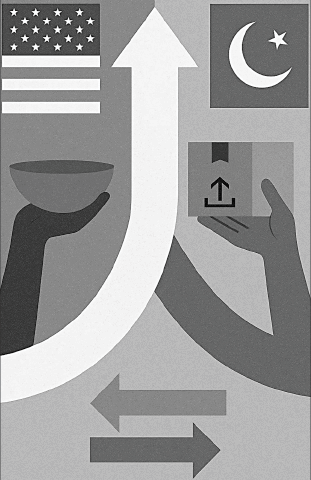
PAKISTAN and the United States seem to be entering into yet another diploma-tically significant era, one that, if executed as intended, could mark a massive diplomatic and economic breakthrough for Pakistan. While the deal looks good on the surface, we must ask ourselves if we are actually entering into a truly stable partnership with the US, or into yet another cycle of conditional goodwill and friendship.
Given our own historical experience, and, indeed, that of a number of other countries with the US, Pakistan must be cautious in our approach. We should be more realistic than optimistic to avoid any costly misstep.
The US is among Pakistan’s largest export markets, but it has a pattern of unpredictable economic engagements, making it a long-term risky partner, especially while considering the current US government’s approach to its one-time allies, like, say, India, which is apparently facing some tough music these days.
Glancing through our own recent history with the US, we can see that the Generalised System of Preferences (GSP), which allowed duty-free exports from Pakistan, was never renewed once it expired in 2020 despite repeated requests.
Similarly, the US has constantly put pressure on Pakistan to abandon the gas pipeline project with Iran, and has even threatened the imposition of sanctions. This interference in a vital energy partnership shows how Washington’s trade stance shifts based on geopolitical interests. There are more such examples in the larger history of bilateral relations between the two countries.
The US has an undeniable history of imposing tariffs and sanctions based solely on a country’s independent decision-making, particularly when it does not align with US interests. This makes any trade partnership with the US inherently unstable, and vulnerable to all sorts of abrupt shifts.
Such a behaviour undermines the very essence of trade sovereignty, and raises valid questions about the reliability of US economic commitments.
While the new Trade and Investment Framework Agreement may sound promising, the fact is that Pakistan has been placed under a 19 per cent reciprocal tariff category. Though reduced from earlier proposals, this modest cut raises doubts: is this a genuine pivot from aid to trade, or another diplomatic manoeuvre masking deeper dependencies?
Even close allies have faced sudden tariff hikes by the US, proving how easily trade terms can shift with Washington’s changing political climate. In this context, Pakistan must tread carefully. Trade should not come with strings attached to foreign policy alignment.
True economic sovereignty lies in di-versification, regional cooperation, and agreements rooted in mutual respect. In embracing new opportunities, we must not forget the lessons of past unpredict-ability, especially when the stakes are high.
For the sake of national dignity and long-term stability, Pakistan must pursue a much more self-respecting strategy, diversifying trade with China, Turkiye, Central Asia and regional blocs to reduce overdependence on any single power.
Memoona Ishfaq
Islamabad
Published in Dawn, August 20th, 2025