0
0

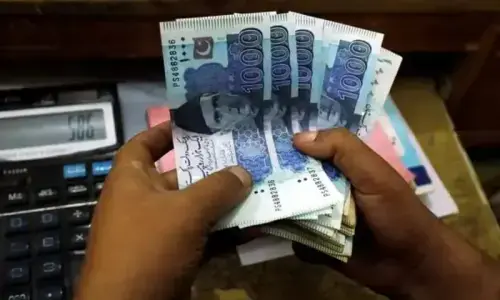
PAKISTAN experienced in the recent past a massive depreciation in its exchange rate, which drove up the domestic price level, resulting in double-digit inflation. Imports became expensive and domestic production using imported raw material and machinery was severely affected.
Public-sector debt servicing rose exorbitantly, and fiscal space for development programmes was severely constrained. Unemployment and the cost of living reached alarming levels, pushing the incidence of poverty from less than 30 per cent to approximately 40pc. This is a brief description of the economic toll the country endured.
The erosion of the rupee’s exchange rate value has been reasonably contained, and its spillover effect on other areas of the economy has been appreciably mitigated. Inflation has significantly declined, and the fiscal deficit — often referred to as the mother of all ills — has been reduced.
Certainly, the stability in the exchange rate has resulted due to policy measures taken by the government, motivated by the recognition that market failure causing havoc to the economy cannot be left unattended. No government in the world leaves the exchange rate at the mercy of free market forces, nor does it wait for macroeconomic fundamentals to align perfectly.
In essence, the foreign exchange market behaves similarly to a commodity market. Speculation, manipulation, future expec- tations, political stability and the very credibility of the central monetary authority and that of the head of the treasury together play a critical role in maintaining exchange rate stability. All these factors were undoubtedly at play while formulating the strategy.
This is not to downplay the importance of the overall demand and supply situation in the foreign exchange market.
If we look at the past trajectory of our exchange rate, non-economic factors, such as those mentioned above, largely explain its fluctuations. Even many developed countries, such as France, Italy, Spain and Belgium, have a debt-to-gross domestic product (GDP) ratio of more than 100pc, but maintain exchange rate stability. The United States is the world’s largest debtor, yet a strong dollar reflects the country’s institutional credibility.
It is a cynical myth to think that exchange rate stability depends solely on macroeconomic fundamentals. Consider the Southeast Asian financial crisis of 1997-98, when economies experienced massive currency depreciation due to a loss of confidence and credibility, even though most of these economies had strong fundamentals. Economics is a science of trade-offs, and no economic policy is without its consequences, which must be addressed through supplementary or corrective measures.
Without doubt, Pakistan’s economy is now better off with exchange rate stability.
Dr Mushtaq Ahmad
Former Chief Economist
Planning Commission
Islamabad
Published in Dawn, August 13th, 2025