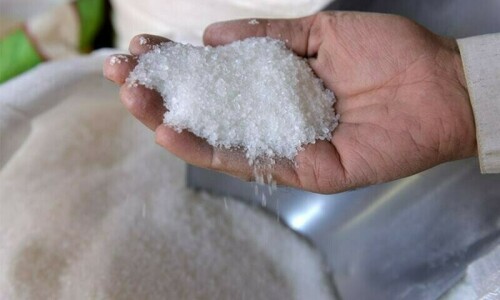
THE revelation by the auditor general of Pakistan that the sugar mill owners have stashed away a staggering Rs300bn in additional profits by heftily raising the retail prices of the commodity after the government granted them export permission is quite instructive. That the industry, notorious for wielding its enormous political clout to profiteer, manipulate policy and steal taxes, has pulled this off again is not just scandalous, it also exposes the deeper malaise of governance failure.
The state has yet again failed to regulate the markets and shield the consumers. The AGP’s testimony before the Public Accounts Committee of the National Assembly underlines how the state often acts to protect the interests of the powerful business lobbies — especially when these interests align with those of the ruling political elite.
What makes the already murky business of sugar even murkier is the opacity around the actual ownership of the mills. It is widely known that a major share of the sugar industry is controlled by those who occupy top public offices and sit in parliament or are closely related to them. In certain cases, these interests are fronted by proxies to obscure the actual beneficiaries.
The government’s inability, perhaps unwillingness, to give the committee anything beyond the names of the mills’ directors reinforces suspicions that the decision to permit sugar exports was made to benefit entrenched political interests. Indeed, PAC chairman Junaid Akbar Khan stated that, more than just poor planning, the practice of first exporting surplus sugar and then importing it at a higher price reeks of deliberate policy manipulation to benefit a group of 42 families. The PAC’s demand for full disclosure of ownership of the sugar mills, therefore, is justified. People have every right to know who, especially among the politically exposed, profits at their expense when public policy is formulated to serve private business interests.
While the PAC is to be commended for demanding transparency, this is not the first time the sugar industry has come under scrutiny for its political clout and policy manipulation. The sugar crisis marked by drastic retail price increases and domestic shortages due to exports in 2020 under the Imran Khan administration had led an inquiry commission that came to similar conclusions. The probe had found evidence of manipulation and profiteering within the sugar industry, and the crisis was attributed to policies that subsidised sugar exports. The commission had made recommendations for regulating the sugar trade, but these have remained unimplemented.
Likewise, the Competition Commission has been unable to recover fines it imposed on the industry for cartelisation and price fixing. Can the PAC break the sugar cartel or curb millers’ influence in policymaking? Given the entrenchment of the owners in politics, there is little room for optimism.
Published in Dawn, July 31st, 2025