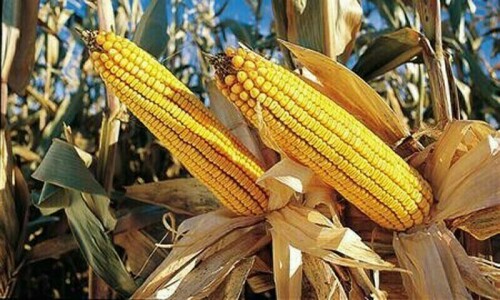
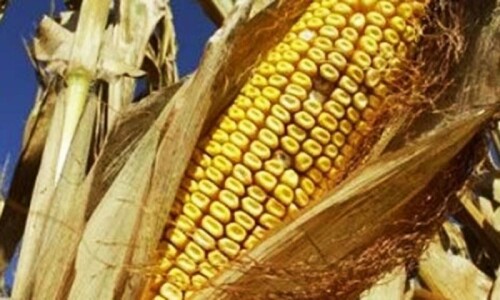
Maize, Pakistan’s fourth-largest crop, is grown for food, feed, and industrial use. It spans nearly 1.64 million hectares, yielding around 9.74m tonnes annually (2023-24). The country grows two maize crops — spring and autumn — but over the past decade, the area of spring crops has steadily expanded, driven by better financial prospects compared to alternative crops.
The harvest of the latest maize crop (spring) has just concluded, and much like wheat, cotton, and rice before it, the yield paints a grim picture. This time, maize has fallen victim to climate change and a host of compounding challenges.
Successive heatwaves and unusually high temperatures in April and May — with national averages soaring 3.37°C and 2.17°C above normal, and April ranking as the second hottest month in 65 years — severely disrupted maize pollination and forced the crop into early maturity. It ripened 15 to 20 days before completing its growth cycle. The damage cut across the board, affecting all seed varieties, whether marketed by local companies or multinationals. Hardly two or three varieties showed slightly better resilience, though none escaped the damage entirely.
Adding to farmers’ woes, warm and humid conditions created favourable conditions for Fusarium wilt — a destructive fungal disease that wreaked havoc across key maize-growing districts (Pakpattan, Sahiwal, and Okara). Additionally, April-May heatwaves have also triggered widespread mite attacks. Altogether, these shocks pushed yields down by 15–20 per cent compared to last year and by over 30pc relative to the 2023 harvest.
Faulty seeds and an early monsoon season rain on its yield expectation as the crop struggles with compounding challenges
To make matters worse, the early onset of the monsoon season in late June disrupted harvesting and post-harvest handling. In a country where sun-drying remains the norm, untimely rains led to higher losses and inferior grain quality.
Furthermore, substandard seed marketed by seed companies, spurious seed sold by dealers, and the black marketing of top-performing varieties dealt a heavy blow to a large number of farmers this year — further squeezing their already fragile farm economics.
A large number of farmers reported poor germination of a famous early-planting seed variety marketed by a well-known multinational. Although the company’s dealers later provided replacement seed, affected farmers had to incur the land preparation, seed treatment, planting, and irrigation costs all over again. More critically, farmers lost valuable time — missing the optimum sowing window ultimately translated into somewhat lower yields.
Likewise, a major seed variety of another multinational suffered from poor grain formation, reportedly due to some technical issue in the seed itself. As a result, many farmers were left with no choice but to use the standing crop as fodder.
Once seen as a promising option for farmers, maize now reflects the deeper crisis in Pakistan’s crop economy with its rising input costs, falling yields, and collapsing market prices
Moreover, the issue of spurious seed continues to resurface year after year, causing heavy financial losses to farmers. To address this, it is imperative for all seed companies to implement a farmer-level digital verification system for seed bags, backed by tamper-proof packaging and seals. Such an initiative should be launched alongside a targeted awareness campaign to educate farmers on seed authentication.
This year, the black marketing of maize seed added another blow to farmers. In early March, two of the top-selling maize seed varieties were sold for Rs27,000 and Rs25,000 per bag (for one acre) — well above their notified prices of Rs20,500 and Rs19,950, respectively. The abrupt ban imposed by the Punjab government on rice nursery sowing (before 20th May) triggered this surge, as many rice growers had to switch to maize, driving up seed demand. Strangely, the government backtracked on its ill-thought decision just four weeks later, on 4th April — after the damage had already been done.
As production costs and crop yield risks climb, the most pinching factor for farmers is the continuously declining maize prices in international markets and so in the local market. In 2022 (annual average), global maize prices were $319 per tonne, which decreased to $253 and then $191 in 2023 and 2024, respectively. Now it is being traded at $ 196 (June 2025). With lower yields and shrinking returns, maize — like many other crops — has become a loss-making venture for most growers.
Currently, most of the maize produced in Pakistan is consumed by the livestock and poultry feed sector, while a sizeable quantity is exported in raw form. Therefore, it is imperative to explore new avenues of value addition, including biofuel production to absorb excess production, stabilise domestic maize prices, especially during seasonal gluts, and create much-needed employment opportunities. Notably, several countries, including Brazil, the United States, India and China, are tapping maize for biofuel production — cutting petroleum oil imports and adding value to surplus grain.
Maize, once seen as a promising option for farmers, now reflects the deeper crisis in Pakistan’s crop economy — rising input costs, falling yields, and collapsing market prices. Without climate-resilient seed varieties, tighter seed regulations, and serious investment in value addition, the maize sector risks further decline — dragging hundreds of thousands of farmers down with it.
Khalid Wattoo is a development professional and a farmer, and Dr Waqar Ahmad is a former associate professor at the University of Agriculture, Faisalabad.
Published in Dawn, The Business and Finance Weekly, July 21st, 2025