0
0
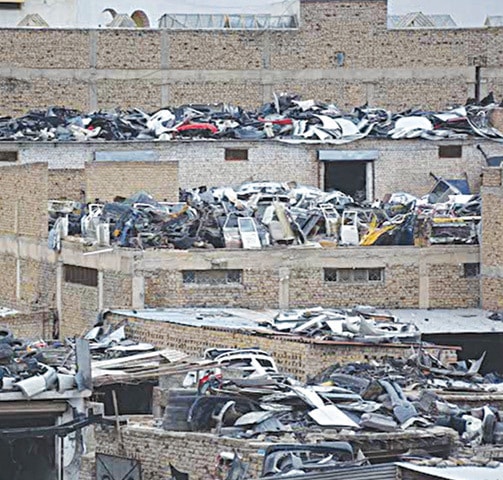
IT seems rather awkward that customs officials only remember to seize non-custom paid (NCP) vehicles when the fiscal year is about to close. For the rest of the year, people can have uninterrupted fun. In Quetta, for instance, it is widely known that most vehicles on the roads are NCP, smuggled in from across the Afghan border.
People from across the country go to Quetta in search of spare-parts for their luxury vehicles because they fully know of not just the availability, but also the availability at a fraction of a price they otherwise have to pay elsewhere. A lot of houses in Quetta serve as spare-part godowns and junkyards, as can be seen in the accompanying image.
This raises a pressing question: how do smugglers manage to bring in such a large number of vehicles when customs authorities have checkposts at all major border crossings and highways?
Although our border with Afghanistan is porous, the main highways have several checkposts that are supposed to monitor and intercept illegal smuggling.
Yet, surprisingly, these vehicles are not intercepted at the border itself, but are instead seized deep within the downtown areas of large urban centres — a practice that seems illogical and contradictory to the purpose of these checkposts.
The unchecked influx of NCP vehicles does not just have economic implications; it has far-reaching social and security consequences. These smuggled vehicles contribute significantly to traffic con-gestion, clogging up already crowded urban streets, and causing frustration to city dwellers.
Worse still, these vehicles are often utilised by notorious elements and non-state actors involved in anti-state activities. This creates massive security challenges for Pakistan.
Not surprisingly, these vehicles are available at amazingly low prices. Therefore, their owners frequently display a reckless attitude towards driving, knowing that they have little to lose. Unfortunately, this not only endangers public safety, but also leads to frequent accidents and a general disregard for all traffic rules.
The official inaction against the illegal sale and purchase of such vehicles, owing to the black sheep within the official machinery, deprives the exchequer of significant revenue.
Addressing the issue requires a comp-rehensive approach that involves not just periodic crackdowns in city centres, but also stricter monitoring at the borders, and genuine accountability.
All the relevant authorities know what is going on. It is time they responded to the urgent need to eliminate the problem.
Shehr Yar Abdullah
Quetta
Published in Dawn, July 20th, 2025