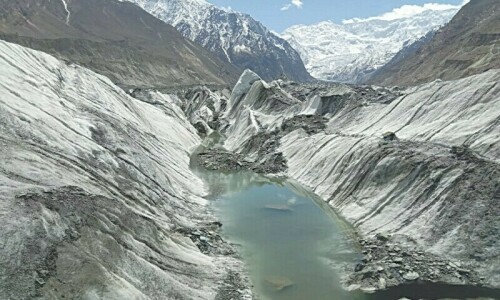
GILGIT: NDMA’s National Emergencies Operation Centre (NEOC) on Wednesday issued a Glacial Lake Outburst Flood (Glof) alert for northern areas, including Gilgit-Baltistan, citing a dangerous combination of persistent high temperatures, intensified monsoon currents and a prevailing westerly wave.
The alert comes as current heatwaves intensify glacier melting across the region, leading to increased water levels and flash floods creating disasters in downstream areas.
A flash flood triggered on Wednesday by a melting glacier occurred in the Burundubar stream, which flows into the famous tourist point Attabad Lake, according to Rescue 1122.
The floodwater blocked access to the Luxus hotel, entering its premises where “a large number of national and foreign tourists were present”.
160 evacuated by boat after flash flooding near Attabad Lake
More than 160 tourists and hotel staff were evacuated by boat.
The flood also damaged trees and land, creating “panic among stranded tourists cut off from land link”.
Elsewhere, rising temperatures triggered flooding in Barga nallah in Skardu, where water “once again entered homes and crops, causing widespread destruction,” police said.
GB Environmental Protection Agency’s (GBEPA) Director Khadim Hussain told Dawn that the frequency of melting glacier disasters “intensified in recent years”.
Mr Hussain attributed this to global climate change and localised factors.
“In old times, snowfall received the mountains in November to December, that was converting into ice, now snowfall in February and March, that couldn’t convert into ice, with heatwaves, the snow melting in speed that causes flooding,” he said.
He added that “localised factors including deforestation, unplanned construction, and tourism influx,” along with increased population and certain energy practices, contribute to accelerated glacier melt.
Another environmental expert told Dawn that many in GB live “in downstream areas of nallahs and rivers and near glaciers,” and when floods hit, “they have no time to save themselves.”
The expert highlighted the broader consequences, saying, “The GB glaciers produce 80pc of Pakistan’s agricultural water. This isn’t just a GB issue — it affects the whole country.”
Concerns were also raised that the GB government “has shown little priority in creating awareness or reducing the risks of climate change and disasters.”
Published in Dawn, June 26th, 2025