Saudi readies for ‘worst case scenario’ in sweltering Haj


Near a sprawling tent city outside Makkah, Saudi hospital staff are preparing for a flood of heat-related cases as Muslim pilgrims begin Haj this week in sweltering summer temperatures.
The Mina Emergency Hospital is one of 15 such facilities operating just a few weeks a year around the annual pilgrimage to Islam’s holiest sites, which in 2024 saw more than 1,300 people die in the desert heat.
Saudi authorities hope to head off a fatal repeat of last year’s pilgrimage when temperatures reached 51.8 degrees Celsius.
Temperatures this year are forecast to exceed 40 degrees Celsius as one of the world’s largest annual religious gatherings, bringing together devotees from around the globe, officially commences on Wednesday.
So far, authorities have recorded 44 cases of heat exhaustion.
Abdullah Asiri, Saudi Arabia’s deputy minister for population health, told AFP at the Mina hospital that “the focus is on heat-related conditions because the Haj coincides with extreme heat”.
Brimming with staff but no patients just yet, the hospital is part of the kingdom’s efforts to prepare for “the worst case scenario” after pilgrims descend on Mina, Asiri said.

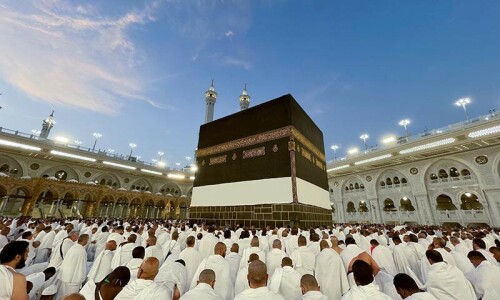
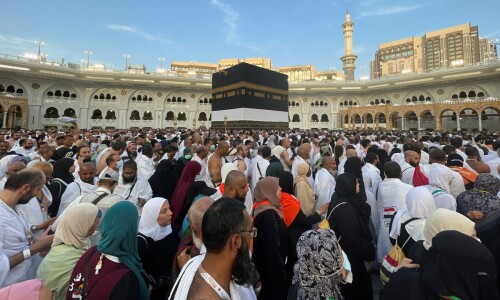
Defying the scorching heat, pilgrims have already started to flock to Makkah. As of Sunday, more than 1.4 million pilgrims had arrived in Saudi Arabia for the multi-day pilgrimage, according to officials.
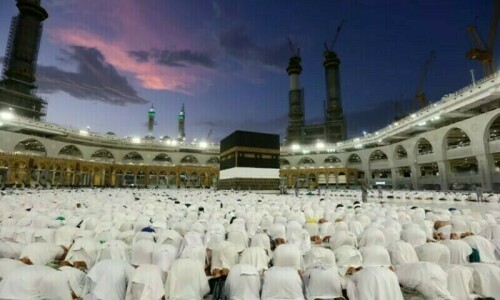
Makkah’s Grand Mosque is serviced by the largest cooling system in the world, according to Saudi state television, with enormous fans and cooled pavements dotting the massive complex.
But outside, hiding from the heat can prove challenging.
Increased capacity
Some pilgrims wear caps or carry umbrellas, but others walk on foot without any protection from the sun, like Palestinian Rabah Mansour, 70, who said that after a lifetime of working outside as a farmer, “heat doesn’t bother me”.
“I have been working in the fields since I was a child,” he said, as sweat trickled down his face.
While many pilgrims may be overcome with religious fervour, Asiri warned devotees against unnecessarily exposing themselves to harsh conditions.
Badr Shreiteh, another Palestinian pilgrim, told AFP that he believed such hardships on the Haj trail would increase the blessings he reaps.
“As you can see, we’re dripping with sweat,” he said, adding: “The more hardship we endure, the more reward we gain.”
According to Asiri, of the health ministry, a total of 50,000 healthcare workers and administrative staff have been mobilised for the Haj, far exceeding previous years’ numbers.
More than 700 hospital beds are ready, equipped with fans to treat severe cases of heat illnesses.
“Capacity this year has been expanded by more than 60 per cent compared to last year,” Asiri said, expecting greater numbers of patients.
“That’s why we are doing all of these measures,” he said.
Last year, medical staff treated 2,764 pilgrims for heat exhaustion and other heat-related conditions, according to the health ministry.
‘Challenge’
To prevent people from needing hospitalisation in the first place, 71 emergency medical points have been set up around Makkah’s holy sites with a focus on “treating patients on the ground before their case deteriorates”, said Asiri.
On the second day of Haj, pilgrims will head to Mount Arafat, climbing it and reciting prayers for the whole day.
Asiri said pilgrims can stay in the shade.
“Most of the heat-related illnesses that happen in Arafat is because people think that they must be under the sun,” he said.
“You don’t have to be outside your tent during Arafat. You don’t have to climb the mountain,” he added, citing no religious obligation to do so, “and it’s very risky from a health point of view”.
Haj Minister Tawfiq al-Rabiah told AFP earlier that thousands of misting fans and more than 400 water cooling units have been deployed.
Authorities built cooled walkways, including a newly completed four-kilometre pathway leading to Arafat.
Last year’s Haj deaths were a high-profile example of the havoc wrought by heat in 2024, which the Copernicus Climate Change Service said was the hottest ever recorded.
Abdul Majid Ati, from the Philippines, said there is “extreme heat, but there are also times that we are inside the (Grand mosque) — it’s extreme cold because of the tiles and of the aircon”.
“We take this as a challenge and a test of our moral character. “