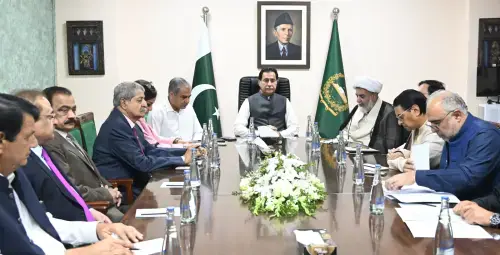
US Secretary of State Marco Rubio may have made the crucial calls that helped de-escalate recent hostilities between Pakistan and India, but China remains the regional diplomatic powerhouse. This was highlighted last week with the trilateral Islamabad-Kabul-Beijing meet aimed at restoring Pak-Afghan ties, spurred by China’s BRI being extended to Afghanistan. For Pakistan to sustain its ties with China, it must remain actively engaged with Beijing’s evolving diplomatic ambitions.
Pakistan for years complained about the shortfalls of America’s diplomatic approach: a transactional relationship dressing itself up as something more. Over time, it grew frustrated with US hypocrisy, the tendency to emphasise topics such as democracy, human rights and religious freedom while circumventing civilian supremacy with US officials engaging directly with the military, or waging drone warfare in violation of rights.
By contrast, China’s explicit transactionalism has been welcome: Pakistan has received investment and military support in return for granting China market and port access and spearheading efforts to counter regional terrorism, including clampdowns on ETIM. All this with little political interference or civil society engagement on Beijing’s part.
Beijing prefers discreet and targeted bilateral exchanges, with little in the way of values- or ideology-focused posturing. As Hao Nan explains in a piece for East Asia Forum, this approach is facilitated by China’s numerous special envoys who are tasked with delivering on particular issues. The envoys enable government-to-government ties, and can expedite negotiations thanks to their direct link with China’s leadership. Unlike ambassadors, they do not get bogged down in engagement with the broader political spectrum.
But something is shifting. China no doubt brokered the Pak-Afghan détente in its own interests, with a mind to stemming terrorism threats to Chinese nationals and assets in the region and revamping its access to Pakistan’s ports and roads and Afghanistan’s mineral deposits. But the mediation comes in the context of softer messaging on China’s regional diplomatic role. Speaking at a news conference, a senior Chinese official emphasised the strategic importance of China’s neighbours, quoting a Chinese saying, ‘a close neighbour is better than a distant relative’.
Beijing prefers discreet and targeted bilateral exchanges.
This language reflects a shift to more holistic diplomatic strategy by the Chinese. The regional trilateral meet took place around the same time that Chinese President Xi Jinping was on the phone with German Chancellor Friedrich Merz, encouraging closer Sino-German ties to weather the storm of US tariffs. This follows China’s decision in April to drop sanctions against members of the European Parliament to improve EU-China ties in the face of US trade warfare. The overture was made despite the fact that ties with the EU will open up engagement on topics such as human rights and environmental standards.
China continues to prioritise increasing its global soft power. The Economist reports that China spends over $10 billion a year to boost its global image. It has established over 500 Confucius Institutes at colleges around the world to promote Mandarin and Chinese culture, and is happy to promote youth-enticing media platforms such as TikTok and video games that feature Chinese content and folk characters. Danish NGO Alliance of Democracies Foundation through polling has identified marked improvements in global perceptions of China.
That said, Beijing’s approach continues to emphasise Chinese economic and security interests where it has the upper hand. Take China’s ties with Russia, for example. President Xi is happy to attend Russian military parades and issue joint statements with Vla-dimir Putin that im-plicitly challenge US dominance. But at the same time, China has not overtly validated Russia’s invasion of Ukraine, provided it much support at the UN or initiated long-term investments in the country. It has instead taken advantage of Russia’s dependency to gain access to cheap natural gas and create a new market for Chinese consumer goods.
As China experiments with the bounds of its diplomatic approach, Pakistan should seek to benefit from a wider relationship, beyond security and counterterrorism. Key areas where Pakistan can benefit from more engagement and knowledge exchange with China would be the green transition and technology, particularly AI. China’s GHG emissions decreased by 1.6 per cent in the first quarter of this year as compared to last year, thanks to its investments in renewable energy and electric vehicles. Islamabad should be courting everything from EVs to renewables to DeepSeek knowhow as part of a deepening relationship with a diplomatically ambitious Beijing.
The writer is a political and integrity risk analyst.
X: @humayusuf
Published in Dawn, May 26th, 2025