Unfortunate that India’s reckless conduct brought two nuclear-armed states closer to major conflict: FO



The Foreign Office on Friday said it was unfortunate that “India’s reckless conduct has brought the two nuclear-armed states closer to a major conflict” as military tensions between Pakistan and India escalate.
The statement comes amid the ongoing escalation between Pakistan and India, which started after New Delhi launched attacks in several Pakistani cities. Islamabad promptly responded to the attacks.
The escalation began following the April 22 attack in Indian-occupied Kashmir’s Pahalgam, killing 26 people. India, without investigation or evidence, implied “cross-border linkages” of the attackers. Pakistan has firmly rejected the claim and called for a neutral probe.
While addressing his weekly press briefing in Islamabad today, FO Spokesperson Shafqat Ali Khan said: “Indian actions are a flagrant violation of the UN charter, international law, and established norms governing interstate relations.
“It is most unfortunate that India’s reckless conduct has brought the two nuclear-armed states closer to a major conflict,” he said.
“India’s jingoism and war hysteria should be a source of serious concern for the world,” he added.
The spokesperson noted that South Asia is home to one-fifth of the world’s population, who can “ill-afford the irresponsible actions like the ones being carried out by India.”
He said that in the wake of the Pahalgam attack, the Indian leadership has “once again used the bogey of terrorism to advance its sham narrative of victimhood, jeopardising regional peace.”
The spokesperson reiterated that Pakistan rejected any attempt to link it to the attack in Pahalgam.
He noted that a number of countries and international organisations had called on both countries to exercise restraint over the past two weeks, and it was “highly deplorable that India did not pay heed to these calls”.
“The international community should hold India accountable for its irresponsible, unlawful and belligerent conduct,” he said.
He rebutted referenced remarks made yesterday by India’s Foreign Secretary Shri Vikram Misri during a press briefing.
“The assertion that Pakistan escalated the situation through the Pahalgam attack of April 22 is totally absurd. To date, India has not been able to produce any credible and verifiable evidence of Pakistan’s involvement in the attack.
“To the contrary, the acts of aggression committed by its armed forces had the approval and support of its entire government,” he said. “Thus, it is India that has escalated the situation by violating Pakistan’s sovereignty and killing civilians.”
He continued that “the Pakistani forces did not attack Pahalgam, but the Indian forces did attack multiple locations in Pakistan,” adding that Pakistan reserves the right to take all measures in its self-defence as enshrined in Article 51 of the UN Charter.
Earlier in the day, state-run PTV said that Pakistan has taken down a total of 77 Indian drones so far.
The spokesperson noted that on April 26, Prime Minister Shehbaz Sharif had called for a “neutral and transparent” investigation into the Pahalgam attack, yet “India chose the path of belligerence and aggression.”
“We are amazed to see the importance that the Indian government attaches to the anonymous and dubious social media posts, upon which it has built the case for The Resistance Front’s involvement in the Pahalgam Attack. Can any country in the world be allowed to attack another country on the basis of a few social media posts? India is attempting to act as a judge, jury and executioner.”
He added that “while India portrays itself as a victim of terror, it conveniently ignores its own role in planning, sponsoring and abetting terrorism in Pakistan.”
The FO spokesperson said Indian claims of targeting terrorists or terrorist infrastructure “are blatantly false [and] it is a matter of record that Indian strikes resulted in the martyrdom of civilians, including women and children.”
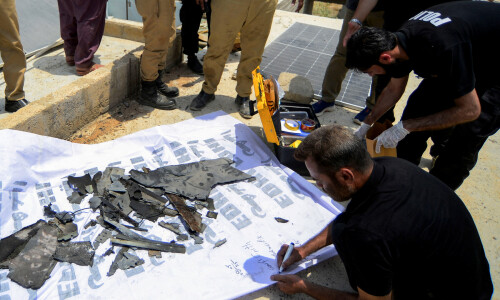
He noted that Pakistan was “well within its rights” to demand that India be held accountable for its “crimes”, referring to Indian strikes on mosques in Pakistan. As many as three civilians were killed when four Indian missiles struck Jamia Masjid Ummul Qura and an adjoining house in Muridke, some 40 kilometres from Lahore.
Khan said that “the current Indian dispensation is bent upon weaponising water; holding in abeyance of IWT is unilateral and illegal.
“Pakistan is an agrarian economy. Millions of people are dependent on the water being regulated by the treaty. The Indian decision is equivalent to an attack on the people of Pakistan and the economy.
“For Pakistan, the Indian announcement is of no legal consequence. The treaty remains enforced and fully binding on the parties,” he said.
He further said that the Indian allegation of Pakistan’s refusal to enter into government-to-government negotiations is incorrect. “Pakistan has been continuously engaged with India on the subject.”
“We particularly regret the Indian foreign secretary’s indecent and undiplomatic remarks that Pakistan has been in the habit of lying since its creation in 1947. We expected better from a diplomat of his status,” he said.
“It is most unfortunate that nowadays, India’s ruling dispensation is trying to rewrite history, making a number of absurd claims. India’s founding fathers must be turning in their graves.
“In fact, India remains a permanent factor of instability in the region owing to its hegemonic ambitions. It has constantly been working to destabilise its smaller neighbours and has stonewalled all efforts to promote regional cooperation.”