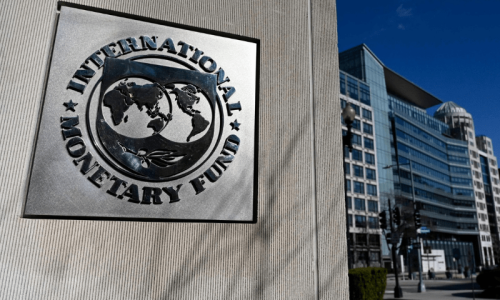
KARACHI: Opening up the automotive sector under the International Monetary Fund’s (IMF) economic liberalisation plan for Pakistan has stoked fears of uncertainty among industry players, claimed an auto assemblers representative association on Saturday.
Under the IMF plan, the government will open the country’s economy to competition with foreign goods by lowering tariffs by as much as 42 per cent over the next five years.
This would mean the weighted average tariff would decrease to 6pc from 10.6pc. Auto assemblers fear that a cut in tariff on the auto sector may be made in two stages: first to 7.4pc and then to 6pc to a maximum 20pc.
The tariff walls of additional customs duty (ADC) and regulatory duty (RD) would also go off in the manner as agreed upon by the government and IMF.
Pakistan Automotive Manufacturers Association (PAMA) Director-General Abdul Waheed Khan told Dawn that he had asked the Ministry of Industries and Production two days back to share the details of the reported agreement with the IMF to preclude the investors’ unease. However, he added that a response from the government is still awaited.
PAMA represents all major assemblers in the auto sector.
He said the news of enormous tariff reduction has been distressful for the industry given its stake.
Mr Waheed said it had been a matter of over four decades since such a high-tech industry was established and sustained through an arduous journey.
Mashood Ali Khan, an auto parts maker and exporter, said that the IMF-driven tariff standardisation would likely lead to a decline in localisation for newer vehicle models besides reversing past progress in the auto industry.
“If tariff standardisation is enforced without strategic planning, it could hinder industrial growth rather than promote it,” he feared.
Realistically, borrowing from the IMF is required to meet the fiscal deficit and generate revenues to repay IMF loans on time. The focus must shift towards industrial growth and expansion instead of such policies that may widen the trade deficit, he added.
The government-IMF policies promulgated over 70 years have not provided essential support to the industry but weakened the economy because they ignored creating a growth-based industrial-friendly environment, Mr Mashood remarked.
He said that policymakers must understand that the only way to generate more revenue depends on robust industrial growth, which also creates employment. “Without a strong manufacturing base, Pakistan risks becoming a nation of traders, leading to job losses and further economic instability,” he deplored.
He said Pakistan cannot afford another experiment that increases reliance on imports for essential goods. The government must take serious steps to develop an export-oriented strategy and engage local industries, including SMEs, to foster trust and ensure policy transparency.
A clear, stable industrial policy is the key to long-term economic resilience, Mr Mashood added.
Pakistan’s auto sales (cars, light commercial vehicles, pickups and vans) surged by a 50pc to 89,770 units during 8MFY25 from 59,700 units a year ago.
Auto sales until the new budget FY26 may remain robust due to improved financing due to declining interest rates, improved consumer confidence and the introduction of new models.
Published in Dawn, March 30th, 2025