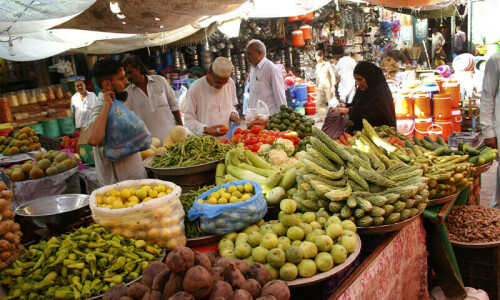
Pakistan’s consumer price index (CPI) inflation rate maintained a sharp deceleration trend on Monday, hitting more than a 9-year low at 2.41 per cent year-on-year (YoY) in January.
The current situation in Pakistan reflects disinflation, which signifies a slowdown in inflation. In contrast, deflation occurs when the general price levels decline.
According to the Pakistan Bureau of Statistics, CPI inflation “decreased to 2.4pc on a year-on-year basis in January 2025 as compared to 4.1pc in the previous month and 28.3pc in January 2024 “.
On a month-on-month basis, the bureau noted an increase of 0.2pc in January 2025 as compared to 0.1pc in the previous month.
Topline Securities, a brokerage firm in Karachi, highlighted that this was the “lowest reading in 111 months”.
“Inflation during 7MFY25 has averaged at 6.5pc compared to 28.73pc in 7MFY24,” it said.
Year-on-year
Urban:
Food item prices that increased included: potatoes (45.14pc), besan (44.72pc), pulse gram (41.73pc), pulse moong (37.33pc), honey (23.24pc), gram whole (21.00pc), and milk powder (20.59pc).
Non-food items prices that increased: motor vehicle tax (168.79pc), footwear (31.88pc), dental services (26.16pc), drugs & medicines (16.56pc), medical tests (15.16pc) and solid fuel (15.10pc).
Rural:
Food item prices that increased: potatoes (49.32pc), besan (45.85pc), pulse gram (45.24pc), pulse moong (37.84pc), milk powder (26.39pc), butter (22.25pc), honey (22.12pc), meat (20.81pc) and fish (18.49pc).
Non-food items that increased: motor vehicle tax (126.61pc), education (23.41pc), dental services (18.41pc) and drugs & medicines (17.48pc).
Month-on-month
Urban:
Food items that increased: chicken (35.26pc), pulse moong (5.43pc), fresh fruits (5.01pc), cooking oil (3.92pc), sugar (3.90pc), vegetable ghee (2.61pc), and sweetmeat (1.83pc).
Non-food items prices that increased: medical tests (5.36pc), solid fuel (2.51pc), dental services (2.22pc), readymade garments (1.60pc), transport services (1.50pc) and house rent (1.45pc).
Rural:
Food items that increased: chicken (33.02pc), fresh fruits (7.82pc), pulse moong (4.84pc), sugar (4.82pc), honey (1.74pc), pulse masoor (1.47pc), vegetable ghee (1.32pc), and readymade food (1.12pc).
Non-food items that increased: doctor clinic fee (4.28pc), woolen readymade garments (3.63pc), house rent (1.89pc), solid fuel (1.73pc), medical tests (1.56pc) and transport services (1.49pc).