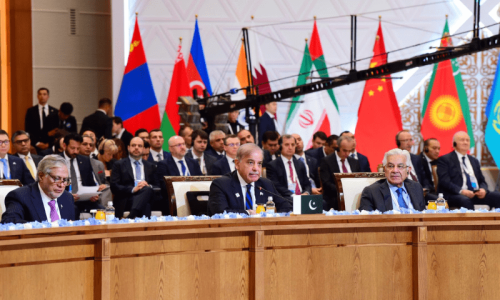
As Pakistan gears up to host the upcoming Shanghai Cooperation Organisation (SCO) Council of Head of Government meeting, the event holds immense geopolitical significance for both the country and the broader South Asian region.
The SCO, a multilateral organisation founded to foster cooperation on security, economic, and political fronts among its member states, has evolved to address issues ranging from trade and counterterrorism to infrastructure development. For Pakistan, this meeting represents a unique diplomatic opportunity — one that comes at a pivotal moment in regional and global realignments.
With global powers reassessing their alliances and the rise of Asia as an economic and political centre, Pakistan’s role as a member of the SCO places it at a crossroads of strategic influence. The increasing prominence of China, Russia’s pivot towards Asia, and the growing importance of Central Asia offer Pakistan a renewed opportunity to assert itself on the world stage.
Pakistan’s strategic location has long been seen as a geopolitical asset, but domestic challenges have often prevented it from fully leveraging this position. Now, through active participation in multilateral platforms like the SCO, Pakistan can secure both economic benefits and diplomatic capital.
The summit can act as a symbolic measure at reducing regional tensions while encouraging trade and cooperation
Pakistan’s dire economic situation — marked by rising inflation, dwindling foreign reserves, and sluggish growth — presents an urgent need for new economic partnerships. This is where the SCO’s economic dimension comes into play. By deepening its ties with member states, Pakistan stands to benefit from regional markets, infrastructure investments, and increased trade flows, particularly through China’s Belt and Road Initiative.
However, the economic gains are not limited to China alone. Pakistan can also enhance its trade relations with Central Asian countries and Russia, fostering economic growth and diversification.
These new economic partnerships could be critical for pulling Pakistan out of its current crisis. In this way, economic cooperation is deeply tied to Pakistan’s broader geopolitical goals, as stronger economic ties will reinforce the country’s strategic importance in the region.
While economic cooperation is key, security remains an equally critical pillar for Pakistan in the SCO. Pakistan continues to face internal security challenges, particularly in its border regions, where terrorism and extremism have persisted.
The SCO’s Regional Anti-Terrorist Structure offers a valuable forum for Pakistan to work alongside regional powers in combating these threats. Furthermore, the forum will also help neutralise the tense situation between Pakistan and China that was created after the recent terror attack on Chinese individuals in Karachi.
Additionally, as Afghanistan remains a source of regional instability following the Taliban takeover, Pakistan has an opportunity to coordinate with other SCO members on managing the security fallout from the situation. For Pakistan, which has borne the brunt of cross-border terrorism and refugee influxes, playing a key role in the regional security dialogue is critical.
The SCO offers a platform where Pakistan can work with neighbouring countries, including China, Russia, and the Central Asian states, to promote stability and prevent the spread of terrorism and radicalisation. In essence, security cooperation within the SCO goes hand-in-hand with economic stability, as regional security fosters the conditions for sustainable growth.
One of the most delicate elements of the upcoming meeting is the relationship between Pakistan and India. Despite ongoing tensions, both countries are members of the SCO, and this multilateral forum offers a rare opportunity for dialogue, however indirect. Pakistan’s invitation to India to attend the meeting signals Islamabad’s willingness to engage diplomatically within a broader regional framework.
Pakistan’s dire economic situation — marked by rising inflation, dwindling foreign reserves, and sluggish growth — presents an urgent need for new economic partnerships
The meeting could serve as a platform for at least a symbolic step towards reducing tensions, particularly on economic matters. With both nations standing to gain from regional trade, the SCO could provide an avenue to ease hostilities through pragmatic cooperation. In this way, Pakistan’s approach to India at the SCO is not only about managing a bilateral rivalry but also about positioning itself as a responsible actor within the larger South Asian and Central Asian region.
The upcoming SCO meeting offers Pakistan a rare diplomatic opportunity at a time when it faces a host of economic and security challenges. For Islamabad, the strategy should be clear: make the case for increased regional cooperation on economic and security issues, highlight the need for regional stability, and showcase Pakistan as a responsible stakeholder in South Asia.
Pakistan must also emphasise its strategic role in China’s Belt and Road Initiative, particularly the China-Pakistan Economic Corridor, and position itself as a key player in connecting Central Asia to global markets. By doing so, it can strengthen ties with not just China but also with Central Asian republics that are eager for greater connectivity and economic integration.
Moreover, by engaging diplomatically with India, even in the face of uncertainty, Pakistan can demonstrate its commitment to peaceful co-existence in the region. A focus on regional cooperation through multilateral forums like the SCO might not immediately resolve bilateral tensions, but it can pave the way for more sustained dialogue in the future.
The author is a research assistant at the Pakistan Institute of Development Economics.
Email: mariajawad61@yahoo.com
Published in Dawn, The Business and Finance Weekly, October 14th, 2024