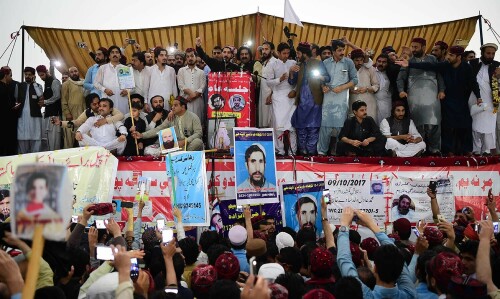
ISLAMABAD: The federal government on Sunday imposed a ban on the Pashtun Tahaffuz Movement (PTM), citing threats to national peace and security.
The PTM was declared “unlawful” under Section 11B of the Anti-Terrorism Act of 1997, according to the Associated Press of Pakistan. A notification issued by the interior ministry mentioned that the PTM posed a “significant danger” to public order and safety in the country, and wans being in the First Schedule of ATA as a proscribed organisation.
Founded in the wake of the killing of Naqeebullah Mehsud, a youth from South Waziristan, the movement and its leader, Manzoor Pashteen, came under severe criticism from the ruling establishment, which accused it of fomenting unrest and working at the behest of foreign agencies, charges PTM leaders denied vehemently.
The move comes in the lead-up to the PTM-initiated Pashtoon Qaumi Jirga, scheduled for Oct 11. In recent days, security agencies in Khyber Pakhtunkhwa had come under fire for raids on PTM camps.
Last week, police in the Khyber tribal district set fire to a PTM camp during multiple raids. The camp was established for the jirga planned for Oct 11.
Both the provincial and federal governments tried to blame each other, with KP government spokesperson Barrister Mohammad Saif claiming that the provincial chief secretary had received orders to this effect from the federal interior ministry.
On the other hand, Interior Minister Mohsin Naqvi questioned the need for a police crackdown on PTM, saying that the action was carried out by KP police, which did not act on the orders of the interior ministry.
In a statement, the Human Rights Commission of Pakistan said the PTM was “a rights-based movement that has never resorted to violence and always used the framework of the Constitution to advocate its cause. This extreme decision was neither transparent nor warranted.”
Ex-MNA Mohsin Dawar, who used to be part of the PTM before forming the National Democratic Movement, also condemned the move.
“This sends a message to families of missing persons and those demanding human rights that the State doesn’t believe in peaceful struggles,” he wrote on X.
In a message on X, former ANP leader Afrasiab Khattak said that banning the movement “days before the peaceful Pashtun conference is a typical colonial act against an oppressed people.”
The Awami Workers Party (AWP), in a statement, said that this will serve only to “antagonise and alienate” the war-torn Pakhtun people and provide space for far-right militancy to thrive.
Published in Dawn, October 7th, 2024