0
0
THOUGH the banned TTP is principally a threat to Pakistan’s security, the terrorist group’s wider ambitions should not be ignored by the world.
In this regard, Pakistan’s ambassador to the UN, Munir Akram, recently told the Security Council that the TTP is an “umbrella organisation” for militant actors, with the potential to destabilise the region. Moreover, indicating the state’s dissatisfaction with the Afghan Taliban regime, he added that the TTP operates with “full support … of the Afghan interim government”.
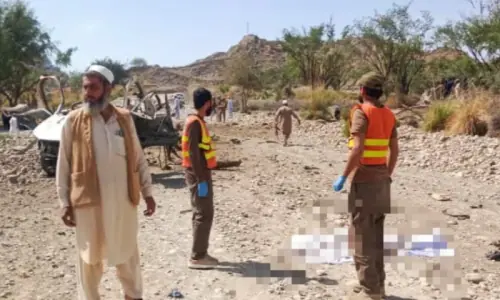
There are, of course, justified reasons for the state’s frustration with the Afghan Taliban’s inability to crack down on cross-border terrorism. In attacks on Thursday and Friday, several security men were martyred, mostly in areas close to the Afghan border. In one incident, terrorists were prevented from crossing into Pakistan, while in another, Pakistani forces traded fire with Afghan security men.
Expanding on the TTP’s potential to cause havoc beyond Pakistan, Mr Akram cited the terrorist group‘s ties with Al Qaeda, saying that the TTP — by joining forces with the multinational terror franchise — could become a “spearhead” for regional and global terrorist goals. The TTP is already on the UN’s radar, as the multilateral body has affirmed that the outfit is currently the largest terror group in Afghanistan, enjoying close bonds with the Afghan rulers.
While there are strong ideological and doctrinal links between the Afghan Taliban and the TTP, the former are satisfied with implementing their rigid system internally, while the latter group has a wider ‘vision’, working as it does with transnational terror concerns. Therefore, as this paper has mentioned before, there is a need to pursue the anti-TTP campaign on two fronts: the domestic and the foreign.
Domestically, the state must ensure that TTP fighters and allied groups are not able to hold any territory or freely cross the Afghan frontier. Our demands for international action will lack conviction if we are not able to keep our own soil free of terrorist groups. Secondly, as the ambassador pointed out, the TTP — particularly its activities inside Afghanistan — should be a matter of global concern, specifically for regional states.
The TTP is not the only violent outfit operating within Afghanistan; Al Qaeda, IS-K, Central Asian fighters, as well as Uighur militants are also believed to have a presence in that country. Some have cordial relations with the Afghan Taliban, while others, for example IS-K, have adversarial ties with Kabul’s rulers. Therefore, Pakistan, along with Iran, the Central Asian states, Russia and China, should evolve a joint strategy to address the militancy problem in Afghanistan.
Pakistan’s warning about the threat the TTP poses should be heeded by the international community, as Afghanistan has remained a hotbed of extremist groups in the past. The same mistake should not be repeated.
Published in Dawn, September 22nd, 2024