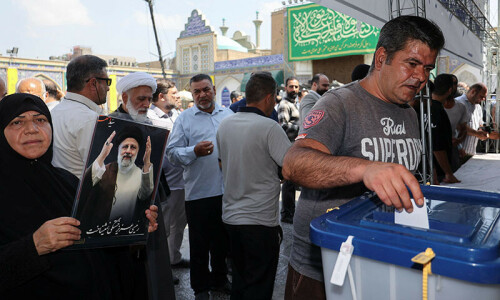
Iran’s supreme leader Ayatollah Ali Khamenei called on Wednesday for voters to participate in Friday’s presidential ballot, saying that historically low first-round turnout was not an act “against the system”.
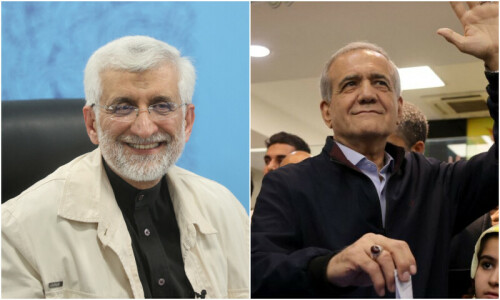
Reformist candidate Masoud Pezeshkian and ultraconservative Saeed Jalili will face off after leading the pack in the first round last week, in an election cycle brought forward by the death of former president Ebrahim Raisi in a May helicopter crash.
Only 40 per cent of Iran’s 61 million eligible voters cast their ballots in the first round, representing the lowest turnout in any presidential election since the 1979 Islamic Revolution.
Khamenei, in a video published by state TV, said it was “completely wrong to think that those who did not vote in the first round are against the system.”
But “participation was not as expected”, added Khamenei, who wields ultimate authority in Iran.
Pezeshkian won 42.4pc of the votes, while Jalili, a former nuclear negotiator, came second with 38.6pc.
As none of the candidates secured more than 50pc of the votes, a runoff round has been set for Friday.
“The second round of the presidential election is very important,” said Khamenei, calling for a higher turnout.
Conservative parliament speaker Mohammad Bagher Ghalibaf, who won 13.8pc of the votes in the first round and did not qualify for Friday’s ballot, has urged supporters to back Jalili in the runoff.
Two ultraconservative candidates who had dropped out of the race also threw their weight behind Jalili.
Reformist figures, including former president Mohammad Khatami, have rallied behind Pezeshkian.
Khatami urged voters to head to the polls in large numbers to “avoid making the situation worse” in Iran.
The elections will be held amid heightened regional tensions over the Gaza crisis, a dispute with the West over Iran’s nuclear programme and popular discontent over the state of Iran’s sanctions-hit economy.