TEHRAN: The first round of Iran’s presidential election revealed shrinking support for both reformists and conservatives even though some voters are pushing for change by backing the sole reformist candidate, analysts say.
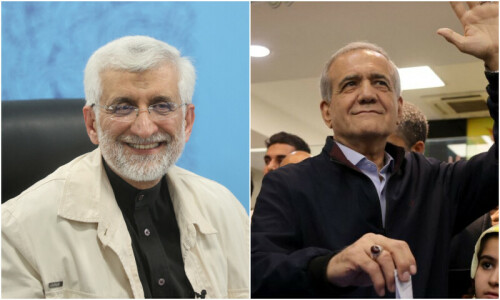
Masoud Pezeshkian, the reformist contender, and ultraconservative Saeed Jalili led the polls held on Friday to replace the late ultraconservative president Ebrahim Raisi, who died in a helicopter crash last month.
Friday’s vote, marked by a historically low turnout, “clearly shows that both reformists’ and conservatives’ bases have considerably shrunk,” said Ali Vaez of the International Crisis Group think tank.
In the lead-up to the election, Iran’s main reformist coalition supported Pezeshkian, with endorsements by former presidents Mohammad Khatami and Hassan Rouhani, a moderate.
“The reformists brought out the big guns and tried their best to mobilise their base,” Vaez said on social media platform X, but “it was simply insufficient.” Likewise, the conservatives failed to garner sufficient votes “despite the tremendous resources they deployed,” he added.
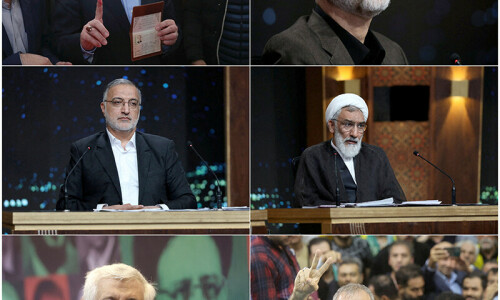
Vaez pointed out that the combined votes of Jalili and conservative parliamentary speaker Mohammad Bagher Ghalibaf, who came in third, totalled 12.8 million.
That figure was well below Raisi’s nearly 18 million votes in the 2021 election.
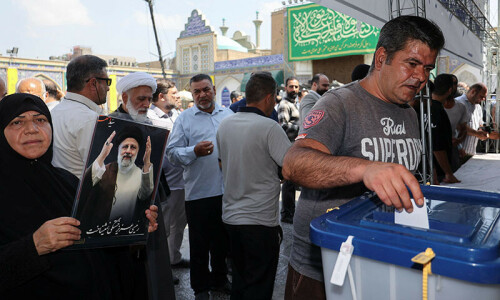
Of the 61 million eligible voters, only about 40 per cent cast ballots, marking a record low turnout in the Islamic Republic where some people have lost faith in the process.
More than one million ballots were spoiled.
For Vaez, the decline in turnout, from around 49pc in 2021, was “a real embarrassment for the leadership” in Iran, where ultimate political power lies with the supreme leader, Ayatollah Ali Khamenei.
Political commentator Mohammad Reza Manafi said Pezeshkian’s lead reflected a push for “fundamental changes” regarding the economy and relations with the rest of the world.
However, those favouring Pezeshkian “do not expect a miracle or a quick solution but hope he can gradually prevent conditions from worsening,” Manafi added.
Iran has been reeling from the economic impact of international sanctions, which have contributed to soaring inflation, high unemployment and a record low for the Iranian rial against the US dollar.
The vote also came amid heightened regional tensions amid fighting in Gaza between Israel and Tehran’s ally Hamas and diplomatic tensions over Iran’s nuclear programme.
Pezeshkian, an outspoken heart surgeon who has represented the northwestern city of Tabriz in parliament since 2008, came out on top thanks to his “clean record without any accusations of financial corruption,” said Manafi.
Official figures showed Pezeshkian with 42.4pc of the vote, against 38.6pc for Jalili. The reformist has urged “constructive relations” with Washington and European capitals to “get Iran out of its isolation.” In contrast, Jalili is widely recognised for his uncompromising anti-West stance.
Published in Dawn, July 1st, 2024