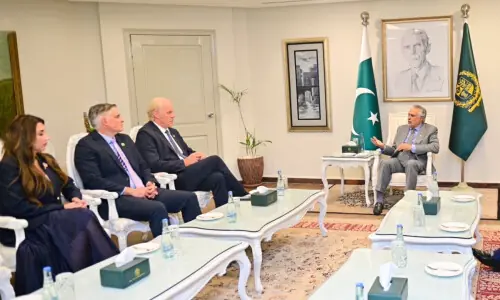
Foreign Minister Ishaq Dar’s recent statement about consultations with stakeholders on the resumption of trade ties with India marks a significant stride towards revitalising the economy and fostering peace in the region.
For decades, it has been evident that major political parties on both sides have advocated for normalising trade relations, but some important stakeholders had reservations. However, the National Security Policy (NSP) announced in 2021 indicated that Pakistan is prepared to move on and prioritise geoeconomics over geopolitics.
We need to recognise the importance of time and make smart choices for our future. Pakistan’s economy has not been doing well: in FY23, it shrank by 0.6 per cent, and it’s predicted to grow only by 2pc in FY24 against a population growth of 2.6pc.
Poverty is already a big problem, affecting about 40pc of people, and it’s getting worse due to high inflation and low growth.
Establishing a bilateral trading relationship could boost Pakistan’s exports by 80pc or $25bn
We need a proactive approach to getting out of such a hopeless situation, and normalising trade with India can bring us many benefits.
First, let’s consider the potential for total international trade growth. According to the World Bank, if we establish a normal trading relationship with India, our exports could increase by a staggering 80pc, or about $25 billion. This could be a game-changer for Pakistan — enhancing our exports, easing our shortage of foreign exchange, and boosting our GDP growth.
Second, this is the shortest route to easing inflation pressure, which has been stubbornly high since the closure of direct trade. To keep inflation under control, the State Bank has to keep the interest rate high. At 22pc, the private sector has stopped borrowing, seriously hurting industrial and GDP growth.
Third, we will save precious foreign exchange, which is currently spent rerouting goods through third countries. Much of this occurs via the United Arab Emirates (UAE), which is currently India’s second-largest export market and Pakistan’s second-largest import market. Some studies suggest that with freight and eliminating other expenses involved with rerouting through third parties, Pakistan could save over $1bn annually.
The cessation of bilateral trade has disproportionately affected our small and medium-sized enterprises (SMEs). For instance, date farmers in Khairpur are forced to sell their produce to middlemen who export their goods via Dubai, significantly reducing their profits. Resuming normal trade with India would offer substantial advantages to economically disadvantaged sections of our society, making regional trade more accessible than exporting to distant countries.
Finally, Pakistan is losing out on new industries being relocated from China to diversify supply chains. Investors look for locations to source raw materials and quickly export to the regional markets. Since India is a major source of industrial raw materials and a big export market, not allowing trade makes goods manufactured in Pakistan uncompetitive.
We’re also missing the chance to grow our trade share through global value chains that make up 70pc of world trade but only 5pc of Pakistan’s.
Some argue that we should not normalise trade relations unless the Kashmir issue is resolved. However, many countries, including China and India, China and Taiwan, and Israel and Arab countries, have border disputes yet continue trading. Pakistan has had this border dispute since independence, yet the founding fathers of both countries did not resort to closing trade.
Some individuals also oppose opening up trade, fearing that India’s potential to export more than Pakistan could worsen our trade deficit. It is crucial to recognise that importing goods from India could replace more expensive imports from other sources and thus reduce our overall trade deficit.
For instance, India’s trade deficit with China amounts to approximately $100bn, and Bangladesh’s deficit with India is around $14bn. Despite these significant trade imbalances, both countries continue this trade as they realise that importing these goods elsewhere would cost more.
Since Pakistan has banned imports from India, it could take the first step of lifting the ban. Of course, India would need to reciprocate by removing extra duties imposed on Pakistani imports. Contrary to the misperception that both countries will have to negotiate a new trade agreement, the Agreement on South Asian Free Trade Area framework already exists.
Perhaps the only complication is the forthcoming elections in India, which will start later this month and continue until June. In the meantime, our government could do some homework on building consensus and make a roadmap on how it intends to proceed.
The writer is a senior fellow at the Pakistan Institute of Development Economics. Previously, he has served as Pakistan’s ambassador to the World Trade Organisation and Food and Agriculture Organisation’s representative to the United Nations in Geneva
Published in Dawn, The Business and Finance Weekly, April 22nd, 2024