THE election is over, government formation underway and the uncertainty of who will govern is coming to an end. But unlike a short Hollywood film, our crisis is not about to end.
In fact, this is a long Bollywood film where one dramatic moment comes midway (interval), allowing for a smoke, a trip to the restroom and some food before the drama resumes. The fear is that the second half will be as suspenseful as the first, with little signs of a happily ever after.
Indeed, on the ground in Pakistan, the indications so far are of further friction and confrontation. This will manifest itself between the provinces, putting pressure on the federation as well as among various political actors. The country’s western part is the most critical here.
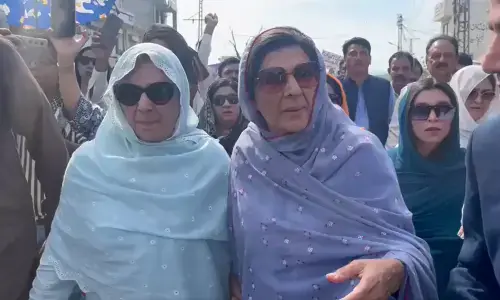
Take Balochistan, for instance, where the confrontation between the province and centre has been brewing for long and recently culminated in the spectacular welcome given to Mahrang Baluch on her return from the dharna in Islamabad. The welcome was a sign of how the ordinary Baloch viewed the manner in which the protesters, primarily women, had been ‘greeted’ in Islamabad.
And if this sense of alienation weren’t enough, the election added fuel to the fire. The results have angered most nationalist parties, which still believed in taking part in the political process. They are now protesting — for example, the National Party, Balochistan National Party and the Hazara Democratic Party.
How the new government will address the issues is unclear, especially as there is little debate or concern for the enormity of the problem. Even if the protests fizzle out, the province has been in conflict with the centre since 2006 and the crisis-ridden polity doesn’t even have the bandwidth to deal with it. If it had, some of the names circulating for chief ministership would not have come up.
In KP, the confrontation, once again, is multilayered. The TTP’s presence here remains the biggest challenge for the armed forces and government. While attacks have come down of late, it’s not clear if the trend will sustain in the coming days. Just the re-emergence of the group has added to people’s anger. Second, the centre has a fractious relationship with the most popular organisations in the province — the PTM, a popular peace movement, and the PTI, which dominates the electoral landscape and will form the government. Chances are this government will also be in confrontation with the centre.
The PTI, by nominating Ali Amin Gandapur, who is alleged to have been involved in the May 9 events and is considered hawkish, has shown it is not going to blink first. The other side also appears to be in no mood to bring the temperatures down. Since Gandapur’s nomination, fresh arrest warrants have been issued for him; the party’s legal troubles including the battles over recounts and notification, are not going its way either.
The two parts of the PML-N government will be forced to work at cross purposes.
Last, the manner in which police from Punjab were sent to KP to arrest Aslam Iqbal also indicates a continuation of hostility. It appears as if the confrontation with KP is set to grow, not just in terms of the people and the centre but also Peshawar and Islamabad. But along with this larger faultiness, is the one within each party which will affect stability as well as governance.
Despite the PTI’s strong electoral performance, the party continues to face legal and political challenges. In addition, their decision to form the government in KP and join the assemblies means there will be friction within on whether to cooperate with the centre and establishment or continue with hostilities, especially if there is no olive branch from the other side.
This is not limited to Imran Khan and his views. The party is not short on either approach. Consider the mild-tempered Barrister Gohar and Sher Afzal Marwat. And in addition, those who are not given a fair hearing or feel the party is not getting relief will be tempted to throw caution to the winds. Unfortunately, people such as Shah Mehmood Qureshi and Salman Akram Raja, who could have provided a calming effect are out of the system for the time being.
However, this internal jostling is not limited to the PTI. The PML-N is not in a much better place. It may have won the government in Islamabad and Lahore but at great cost — its domination of central Punjab is under threat. The PTI has parked itself on GT Road in a manner that no party has been able to in recent years. And it is to push back against the PTI that PML-N was very keen to take control of Punjab again, agreeing to the poisoned chalice that is the federal government.
Now, however, the two parts of the PML-N government will be forced to work at cross purposes. The one in Punjab will want to spend money to regain its political capital, while the centre will be trying to control the fiscal deficit and spending by the provinces. In this latter task, Islamabad will have to try to not just stop Punjab but also its ally in Sindh and its rival in KP from spending money. However, in Punjab, the challenge will be the greatest, as it may add to the tensions within the ruling family.
Indeed, the economy will continue to be the biggest variable in our politics for the short- and mid-term and will cause the greatest pressure on the system and some of the faultiness identified.
In the coming days, Islamabad and the provinces will be confronted with the decision of continuing to raise utility prices and existing taxes (which so far is the easiest of the ‘difficult’ decisions governments take) to making efforts to broaden the tax base and carry out privatisation.
The first, by increasing the burden on the people, will antagonise citizens in general, while considerations to impose new taxes on either the retail sector, agriculture, or property will strain relationships within parties, within allies and between the civilians and others. The second half of this desi film will not be easy viewing.
The writer is a journalist.
Published in Dawn, February 27th, 2024