LAHORE: The Lahore High Court has ruled that sections 298 B & C, which criminalise certain acts of the Ahmadi community, do not mandate razing or altering the structures built before their inclusion in the Pakistan Penal Code (PPC) through a 1984 ordinance.
“I cannot understand how the doctrine of continuing offence is attracted to the facts and circumstances of the instant case,” Justice Tariq Saleem Sheikh observed in a detailed verdict issued on a pre-arrest bail petition of two members of the Ahmadi community.
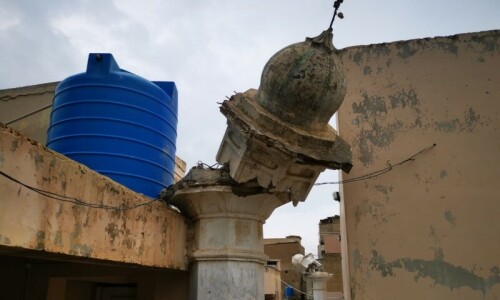
Wazirabad city police had registered an FIR under sections 298 B & C of PPC stating that the Ahmadis built a worship place comprising a room with a minaret, which is an architectural feature and a religious symbol important to Islam.
According to the complainant, it was an insult to the religious feelings of the Muslim population of the locality and a perpetual source of pain and anguish for them. Since the petitioners were managing the affairs of that worship place, they were liable under the law.
A counsel for the petitioners contended that the contents of the FIR did not constitute any offence under the PPC. He further submitted that the worship site (known as Baitul Zikar) was constructed in 1922, while sections 298-B & C were inserted in the PPC through an ordinance of 1984.
A deputy prosecutor general and the complainant’s counsel opposed the bail petition. They stated that it was illegal for the Ahmadis to build their place of worship in the style of a traditional Muslim mosque. Even though Baitul Zikar was established in 1922, the petitioners were obligated to change its outlook and pull down the minaret, which was identified with a Muslim mosque, following the promulgation of the 1984 ordinance.
Since this has not been done, it constituted a continuing offence and the petitioners, as the current custodians, can be prosecuted, they added.
Justice Sheikh observed that the essence of the complaint against the petitioners was the Islamic-style minaret of their worship place.
“True, the minaret is a religious symbol for Muslims, but it is also an architectural feature,” the judge said.
He noted that the earliest mosques lacked minarets as at the time of the Holy Prophet Muhammad (PBUH), the call to prayer (Azan) was made from the highest roof near the mosque.
The judge said varying theories exist about the origin of minarets as some scholars think that early Muslims adopted Greek watch towers to call people to prayer, which Muslims used for their own purposes before deciding to create their own architectural structure.
Others, he said, believe that the Ziggurat towers of the Babylonian empire inspired the minaret.
Justice Sheikh wrote, “I do not need to determine in these proceedings whether sections 298-B and 298-C PPC prohibit and criminalise the construction of a worship place by Qadianis resembling a mosque. However, in my opinion, they do not mandate that the structures built before the promulgation of Ordinance XX of 1984, by which these provisions were introduced, should be razed or altered.”
The judge noted that Ahmadis built the worship place in question way back in 1922 and inscribed Baitul Zikar at its doorway. And the petitioners are just its caretakers.
“I wonder if they can be punished for an architecture crafted a hundred years ago,” the judge added.
The judge observed that the complainant did not explain why he kept mum for about 38 years after the promulgation of Ordinance XX of 1984 and what prompted him to lodge the FIR in 2022.
Rejecting the argument of the continuous offence, Justice Sheikh maintained that when the Ahmadis built their worship place, its architectural design did not violate any law then in force.
The judge had allowed the pre-arrest bail to the petitioners.
Published in Dawn, September 14th, 2023