ISLAMABAD: Chief Justice of Pakistan (CJP) Umar Ata Bandial on Wednesday initiated a suo motu proceeding to determine who has the constitutional responsibility and authority to announce the date for election to a provincial assembly after it was dissolved in different situations, under the Constitution.
Keeping in view the importance of the matter, the CJP set up a nine-judge Supreme Court bench to consider, among other questions, how and when was the constitutional responsibility of holding elections be discharged and what were the constitutional responsibilities and duties of the federation and the provinces with regard to holding of general elections?
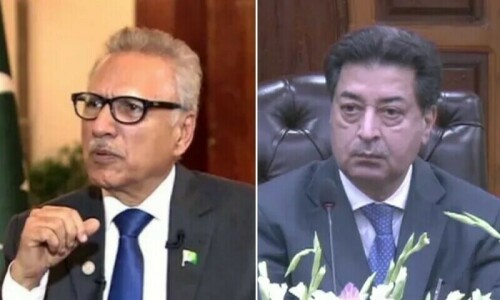
The bench, headed by CJP Bandial, will consist of Justice Ijaz ul Ahsan, Justice Syed Mansoor Ali Shah, Justice Munib Akhtar, Justice Yahya Afridi, Justice Sayyed Mazahar Ali Akbar Naqvi, Justice Jamal Khan Mandokhail, Justice Muhammad Ali Mazhar and Justice Athar Minallah. The case will be taken up on Thursday (today) at 2pm.
In his order, the CJP observed that there was, to put it shortly, a lack of clarity on a matter of high constitutional importance.
CJP initiates suo motu action, constitutes nine-judge bench to take up case today
The issues raised require immediate consideration and resolution by the Supreme Court. The decision was taken after a note was presented to the CJP against the backdrop of a Feb 16 order by a two-judge bench asking the chief justice to invoke a suo motu initiative in this regard.
“Several provisions of the Constitution need to be considered, as also the relevant sections of the Elections Act 2017. In particular, the issues involve, prima facie, a consideration of Article 17 of the Constitution and enforcement of the fundamental right of political parties and the citizens who form the electorates in Punjab and Khyber Pakhtunkhwa to exercise their right to elect representatives of their choice to constitute fresh assemblies and the provincial cabinets,” the SC order said.
“This is necessary for governments in the two provinces to be carried on in accordance with the Constitution,” observed the CJP, adding that these matters involve the performance of constitutional obligations of great public importance apart from calling for faithful constitutional enforcement.
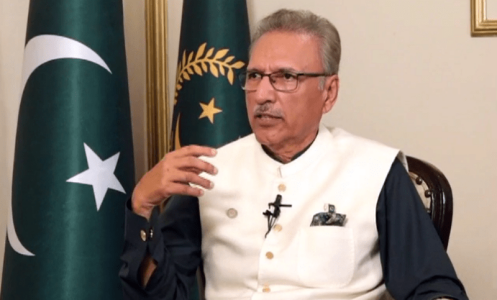
“There is a material development in the last few days,” the CJP noted, adding that it appeared that the subsequent to certain correspondence initiated by President Arif Alvi with the Election Commission of Pakistan, the former had taken the position that it was he who had the authority and responsibility for appointing a date for the general elections, in terms as provided in Section 57(1) of the Elections Act.
The order said: “By an order made on Feb 20, the President had appointed April 9, 2023 to be the date for the holding of the general elections in Punjab as well as KP and had called upon ECP to fulfil its constitutional and statutory obligations in this regard.
More than one month has now elapsed since the dissolution of the provincial assemblies and it seems prima facie that even the matter of appointing the date of general elections which was a first step towards the holding of the elections, has still not been resolved.
“Constitutional authorities appear to hold divergent and perhaps even conflicting, views on the issue, and thus several federal ministers appear to have contested the authority asserted by the president. Since ministers act under the constitutional rule of collective responsibility, it appears, prima facie, that this is the view taken by the federal cabinet as a whole.
“It is also to be noted that statements attributed to ECP have appeared in the public record to the effect that it was not being provided the requisite assistance and support, in particular by the provision of necessary funds, personnel and security, as would enable it to hold the general elections in accordance with the Constitution.”
The CJP observed that in the cases of Punjab and KP, the then chief ministers tendered advice to their respective governors under Article 112(1) of the Constitution to dissolve the assembly.
In Punjab, the governor chose not to act on the advice so that the assembly stood dissolved on the expiry of 48 hours, on the date mentioned above, the order recalled. Whereas in KP, the governor did act on the advice and made an order dissolving the assembly on Jan 18. Almost immediately after the dissolution of both assemblies, a question was raised as to who had the constitutional responsibility and authority to announce the date of elections to obtain the mandate of the electorate and elect fresh assemblies, it added.
Published in Dawn, February 23rd, 2023