0
0

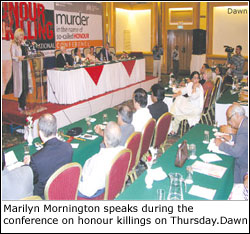 KARACHI, Nov 24: Speakers at the inaugural session of a three-day international conference on honour killings on Thursday blamed the inefficient and complex judicial system for failing to take prompt and effective steps against Karo-kari.
The three-day international moot “Murder in the name of so-called honour” has been organized by the British Council in collaboration with the Dastak Communications, Tehrik-i-Niswan, Human Rights Education Forum, Inter-Press Communication and Sindh Police. Experts from Afghanistan, Bangladesh, India, Jordan, Turkey and UK are also attending the conference.
Sindh Education Minister Dr Hameeda Khuhro, who is also the chairperson of advisory committee on anti-honour-killing project, stressed the need for an unambiguous legal system. The provincial minister said that there was a need of simplified and very clear legal system which could also be understood by a common man.
The minister said that the world failed to grasp gravity of this issue that paved way for society to accept honour killing as integral part of culture. She said it was in fact a crime that needed to be eliminated immediately for development of society. She underscored the need for comprehensive and permanent approach in this regard, considering the sensitivities involved.
She said law and punishment for honour-killing crime should be made strict and awareness among people on the issues of domestic violence and self-righteousness of women must be raised.
Dr Khuhro lamented influential elements from rural areas hindering the up gradation of legal system. The lack of acceptance of severity involved in the matter by society had also stalled human resource development, she viewed.
Director Legal–Aid Cell and Advocate Supreme Court of Pakistan, Hina Jilani, said that civil society must be appreciated the manner in which it had brought into light the incidents of honour killings. She said that under Pakistan Penal Code there were certain provisions that were intercepted as if the honour killing was not wrong.
Referring to a judgment of the Lahore High Court in 1980’s, Hina Jilanai said that a man who had killed his wife was awarded less sentence, as his crime was in the name of honour.
She said that though numerous cases of honour killing were reported, only a few criminals were convicted. She said there was need for State to realize its duties in safeguarding vulnerable people of society, especially women. She recalled in 1999 when a law in this regard was presented in Senate, lawmakers refused to let the law be even tabled in upper house on the pretext that it was interfering with ‘honour’.
“Now there is a law, worthless it is, but at least reflects realization among concerned quarters that there persists some problem,” she stated.
Now the laws had been formulated in such a manner that only the respective family could pardon its member being the heirs of victim like sister, mother, daughter and wife, she explained.
Marilyn Mornington, District Judge Liverpool, the UK, said that the UN estimated that approximately 5,000 honour killings were perpetrated worldwide each year. “For every woman killed, a thousand more live in fear,” she remarked.
In the United Kingdom, she said, police had developed innovative ways of analyzing, understanding, investigating and preventing honour-based violence.
She said that honour killings were ‘atypical’ and they fell within the umbrella of honour crime and domestic violence. Many of these crimes are interlinked being drivers for one another such as domestic violence, forced marriage, acid attacks, dowry related crimes, bride price, female genital mutilation, honour rape and blood feuds.
Marilyn Mornington said that victims were often subject to psychological pressures that could lead to mental breakdown, self harm and even suicide. Forced marriage was not solely a ‘Muslim or South Asian’ problem. The Forced Marriage Unit (FMU) has dealt with cases from East Asia, Africa, the Middle East and Europe, she said. She said that over the last four years, the UK government helped almost 1,000 cases of forced marriages and rescued and repatriated around 200 young people from overseas. However, many more cases were not reported and others were dealt with by other agencies.
She said, “There has been a great deal of research and international cooperation on these issues, yet we seem powerless to date to effect change. We now understand the misguided concept of honour- that crime committed in its name is based in feudalism, lack of education and denial of the fundamental human rights to women.”
Earlier, Director British Council Marcus Gilbert said that the anti-honour-killing project was a part of the UK-funded programme for improving relations with the Islamic world. He said the whole effort was aimed at involving various strata of society like police, judiciary, academia and media for removing the menace imbibed in culture of not only Pakistan but also many other countries, including Egypt and Israel.
Ron Rimmer, Deputy Head of British Mission in Karachi, presented votes of thanks.
The inaugural session of the conference was followed by a poster exhibition displaying honour killings as perceived by students from rural localities of Sindh and southern Punjab provinces.