A narrow vote in the House on Thursday rejecting limits on presidential war powers highlighted a growing clash between President Donald Trump’s approach to the conflict with Iran and Congress’s constitutional authority over military action.
The House voted 219–212 against a resolution that would have required the president to seek congressional authorisation before expanding US military operations against Iran. A similar effort in the Senate failed earlier, leaving the administration free to continue its current campaign.
The resolution, introduced by lawmakers from both parties, sought to reassert Congress’s authority under the Constitution to approve acts of war. Its defeat underscored the sharp partisan divide on Capitol Hill over the administration’s strategy.
“Today, I voted for the War Powers Resolution to put an immediate stop to President Trump’s unlawful war with Iran,” said Representative Judy Chu, a California Democrat. She argued that the administration had presented “no imminent threat” that would justify continuing hostilities without congressional approval. “This war has already claimed the lives of six American service members and countless civilians,” she added.
Another supporter of the measure, Representative Mike Levin, also a California Democrat, framed the vote as a constitutional issue.
“Article I is not a suggestion. It is the supreme law of the land,” Levin said. “The Framers did not vest the power to declare war in a single executive.”
Supporters of the president argued that restricting the administration’s authority in the middle of a confrontation with Iran would undermine national security.
Representative Brian Mast, a Florida Republican who chairs the House Foreign Affairs Committee, said the resolution was effectively asking “that the president do nothing” while US forces faced threats in the region.
Trump signals interest in Iran’s leadership transition
As lawmakers debated the war powers measure, Trump offered unusually direct comments about Iran’s political future, suggesting that Washington should have a say in the country’s leadership transition.
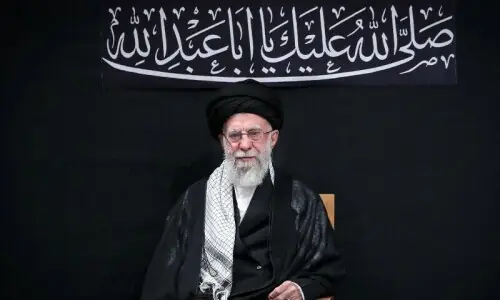
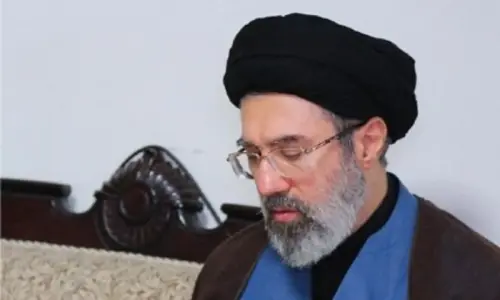
In an interview with Axios published Thursday, the president dismissed the possibility that Mojtaba Khamenei, widely viewed as a potential successor to Supreme Leader Ayatollah Ali Khamenei, should assume the position.
“They are wasting their time. Khamenei’s son is a lightweight,” Trump said. “Khamenei’s son is unacceptable to me. We want someone who will bring harmony and peace to Iran.”
Trump also suggested that the United States should be involved in shaping Iran’s future leadership.
“I have to be involved in the appointment, like with Delcy [Rodriguez] in Venezuela,” he said, referring to what he has described as a successful US-backed transition there earlier this year.
Speaking separately to Reuters, Trump reiterated that the United States should play a role in determining Iran’s next leadership.
“We want to be involved in the process of choosing the person who is going to lead Iran into the future — somebody that’s going to be great for the people, great for the country,” he said.
Analysts say such remarks are likely to provoke strong reactions in Tehran, where political authority rests within a complex system of clerical bodies and institutions that traditionally resist external influence.
Tehran reacts angrily
Iranian officials responded sharply to the comments and to the expanding conflict.
Foreign Minister Abbas Araghchi accused the United States of escalating tensions and warned that recent American actions, including attacks on Iranian military assets, would have consequences.
As the confrontation enters its sixth day, explosions have been reported in Tehran amid continuing strikes and counterstrikes. Iranian drones and missiles have targeted Israel, U.S. military facilities and regional infrastructure across the Gulf, raising fears that the conflict could widen further.