IN times like these, when war is raging in the neighbourhood, it is important for the state to bring on board all stakeholders, particularly political parties, to formulate a national response to the related crises. In this regard, the government did the right thing by inviting the leaders of parliamentary parties for an in-camera briefing focusing on regional tensions. All major parties attended the moot on Wednesday — except for the PTI, which was invited but declined to attend, stating that it should be allowed to meet Imran Khan first. A rather formulaic handout was issued after the meeting, stating that the participants highlighted the “need for national unity” while reiterating their commitment to the “eradication of terrorism”. Both the hostilities with Afghanistan and the war raging in the Middle East were discussed.
The fact that the majority of politicians put up a show of unity at this critical juncture has symbolic significance. And the PTI’s grouses with the current regime notwithstanding, the party should have attended the briefing. Matters of national security and foreign policy should be above party politics, and as a party that has run a government at the centre, the PTI’s input would have been important. We have seen the merits of collective wisdom in the past — for example, in the case of the Saudi-led war against Yemen’s Houthis. Parliament’s decision in 2015 to stay neutral in that disastrous conflict was the right one, and reflects the fact that when elected representatives come together for national causes, the outcomes can be positive for the country.
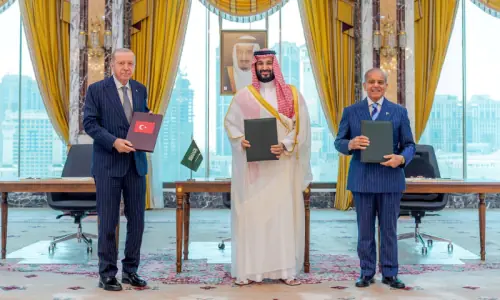
Today, Pakistan finds itself at a similar juncture vis-à-vis its foreign policy. A brutal war is being waged against its western neighbour Iran, and Pakistan has condemned the aggression against it. Yet, it is also a fact that Pakistan has a defence pact with Saudi Arabia — which, along with other GCC states has come under Iran’s counter-attack. Foreign Minister Ishaq Dar has said the defence pact was mentioned to Iran, and that Tehran had tempered its attacks against the kingdom. He also condemned the targeting of GCC states. Pakistan has long-standing cultural, economic and political links with the sheikhdoms, and keeping quiet was not an option. Where the US is concerned, while the American-Israeli aggression against Iran is utterly indefensible, Pakistan has condemned the hostilities in general terms, perhaps not wanting to rub President Donald Trump the wrong way. It is indeed a difficult situation for Pakistan to be in, as it has to maintain a deft balancing act between friends, neighbours and benefactors, while condemning aggression against a sovereign state, and the assassination of its leadership. It is therefore hoped that solid suggestions were made at the in-camera briefing that can help Pakistan ride out this perilous regional storm while maintaining moral clarity.
Published in Dawn, March 5th, 2026